It’s not every day that a centuries-old space mystery gets solved. But after more than 400 years of questions, astronomers may have finally figured out how globular clusters form—those dense, ancient star clusters that puzzled scientists for generations. The answer? It not only solves a cosmic riddle but also uncovers an entirely new type of stellar system hiding dark matter within our very own Milky Way.
Let’s break down this incredible discovery and how it changes our knowing of the universe.
Table of Contents
Clusters

Back in 1665, a German astronomer named Abraham Ihle first spotted a bright clump of stars in the Scorpius constellation. That object, later named M22, was the first known globular cluster—a ball of stars tightly packed together, like a glowing snow globe hanging in space.
Since then, astronomers found many more of these clusters, most of them billions of years old. But here’s the weird part: while dwarf galaxies (similar in size) are packed with dark matter, globular clusters seem to have none.
This led to two big questions:
- How can two objects so similar be so different?
- Could there be something in between—something we missed?
EDGE

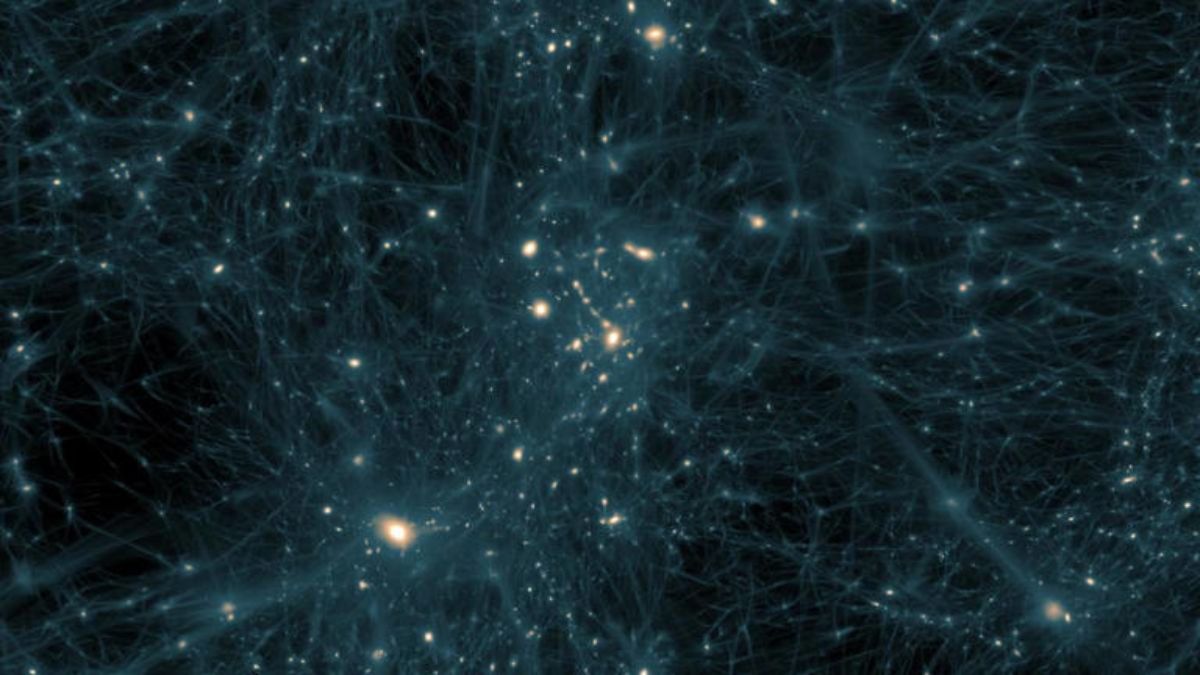
To solve the puzzle, researchers turned to EDGE (Engineering Dwarfs at Galaxy formation’s Edge), a high-resolution simulation that runs on one of the UK’s most powerful supercomputers, DiRAC.
EDGE allowed scientists to simulate how stars, dark matter, and galaxies evolved—right down to the explosive effects of supernovas.
The result? They didn’t just recreate globular clusters and dwarf galaxies. They discovered a third kind of object, something completely new that had been hiding in the data all along.
GCDs
The new discovery is called GCDs, short for Globular Cluster-like Dwarfs. They look like globular clusters, but they behave more like dwarf galaxies—especially when it comes to dark matter.
GCD Features:
| Feature | Description |
|---|---|
| Appearance | Looks like a star cluster |
| Contains dark matter? | Yes |
| Formation history | One quick starburst, then silence |
| Size | 10–60 parsecs wide |
| Mass-to-light ratio | Higher than globular clusters |
| Metallicity ([Fe/H]) | Extremely low, under –2.75 |
These new systems might be cosmic fossils, containing stars born from the early universe’s untouched gas, also known as Population III stars.
Hidden
Here’s where it gets exciting: some of these GCDs might already be known to us—but misclassified. The study points to several candidates hiding in plain sight within the Milky Way:
- Reticulum II
- Boötes II
- Draco II
- Eridanus III
These systems were assumed to be either globular clusters or tiny dwarf galaxies, but now researchers think they could be true GCDs—a unique mix of both.
Dark
Why does this matter for dark matter?
Well, dark matter remains one of the biggest cosmic mysteries. But the existence of GCDs helps narrow it down. If these hybrid systems really formed in small dark matter halos, it suggests that the mass and temperature of dark matter particles had to allow them to exist.
That means if we study GCDs carefully, they could help us figure out whether dark matter is:
- Cold (slow-moving particles)
- Warm (mid-speed)
- Hot (fast-moving)
One theory suggests that if dark matter is made of thermal particles around 10 keV, it would prevent GCDs from forming at all. So if we see GCDs, that limits what dark matter can’t be.
Next
This discovery doesn’t just solve a 400-year-old mystery. It also gives astronomers a new lens to look at the early universe. Since GCDs could hold some of the oldest, metal-free stars, they’re like time capsules. Studying them might help scientists find clues about how the first stars and galaxies came to be after the Big Bang.
Who would’ve thought that a question first asked in 1665 would help us unlock the secrets of dark matter in 2025?
FAQs
What is a globular cluster?
A compact group of ancient stars tightly packed together.
Do globular clusters contain dark matter?
No, they appear to lack dark matter unlike dwarf galaxies.
What are GCDs?
They are hybrid star systems with both stars and dark matter.
Can GCDs help study dark matter?
Yes, they help test which dark matter types can exist.
Where are GCDs found?
Some may be hidden in the Milky Way, misclassified as clusters.