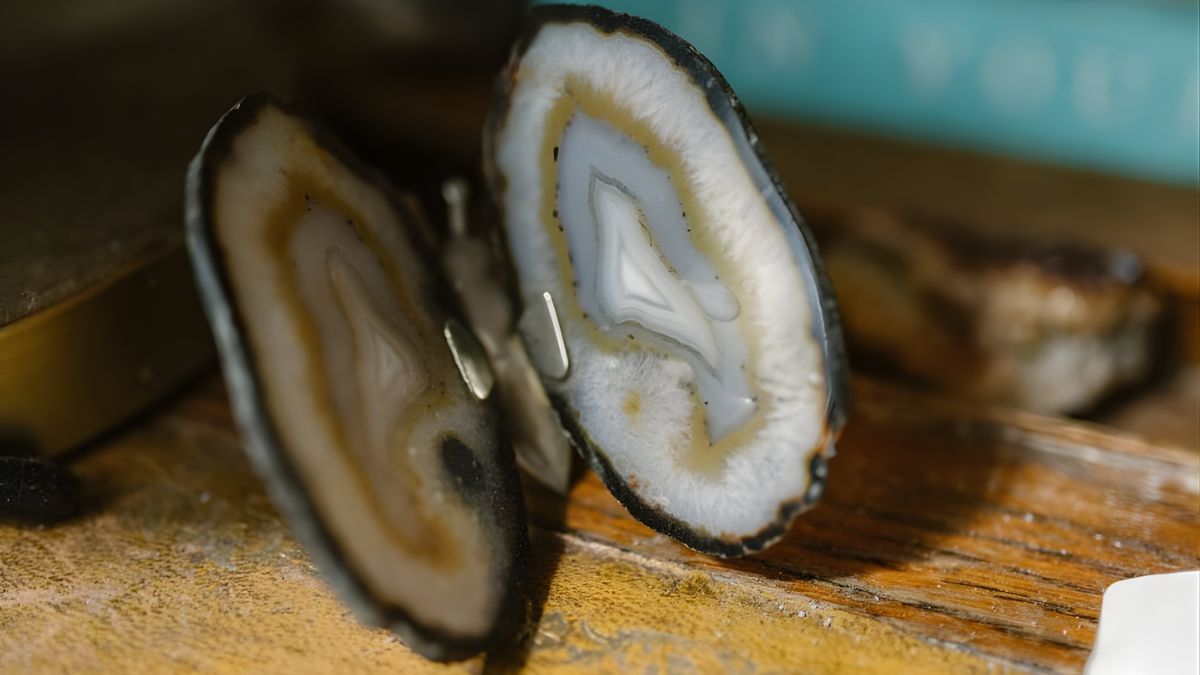
For over a century, a curious pink-and-white round stone sat quietly in the halls of the Natural History Museum in London. To most people, it was simply a beautiful agate—large, glossy, and nothing more than a decorative mineral.
But everything changed after one observant curator gave it a second look. What had been considered an ordinary stone turned out to be something far more extraordinary: a fossilized titanosaur egg.
Table of Contents
Discovery

In 2018, Robin Hansen, a museum curator, was preparing an exhibition when he came across the pink agate. Drawn in by its color and near-perfect round shape, he found it oddly captivating. But it wasn’t until a trip to France, where he saw a very similar specimen labeled as an agatized dinosaur egg, that a light bulb went off. Could the museum’s “decorative rock” be the same?
He rushed back to London, compared the two, and began questioning the long-held assumption about the stone’s origin. What followed was a detailed investigation involving other experts. They examined the stone’s texture, outer surface, symmetry, and mineral layering. Everything pointed to one conclusion—it wasn’t just a rock. It was a fossilized egg from millions of years ago.
Origin
The egg is believed to come from India, a region known for its rich deposits of dinosaur fossils, particularly titanosaurs. These enormous plant-eating dinosaurs roamed Asia in prehistoric times and were known for laying numerous eggs at once—usually between 30 and 40. Unlike many modern animals, titanosaurs didn’t care for their young. They laid the eggs and left them to survive on their own, making fossilized nests a fairly common find in some parts of the world.

This particular egg measured around 15 centimeters in diameter, which is consistent with titanosaur eggs previously discovered in India and China. Its thick shell, almost perfectly round shape, and external texture were all classic indicators of a dinosaur egg. And thanks to the volcanic activity in that region at the time, the egg’s interior was eventually filled with silica-rich water, slowly transforming it into agate over millions of years.
Preservation
What makes this discovery especially fascinating is the process by which the egg turned to stone. The unique volcanic environment allowed mineral-rich water to seep into the egg’s cavity. Over time, this process created the crystal bands visible inside the egg today—bands that make it look like a striking, pink gemstone.
Attempts were made to scan the inside using CT technology, but the density of the agate made it impossible to see through. Still, the external features were enough to confirm what the museum had unknowingly displayed for decades: a fossilized dinosaur egg hiding in plain sight.
Hidden in Plain Sight

It’s wild to think that this specimen was sitting under everyone’s nose for nearly two centuries. Displayed to millions of museum visitors as just another interesting rock, its true identity was overlooked. But that’s the beauty of science—it evolves. New tools, new eyes, and fresh perspectives can turn something once thought mundane into something truly mind-blowing.
This discovery serves as a gentle reminder that science is never static. What we accept as fact today can change tomorrow with the right observation or a shift in perspective. That once “common” agate became a window into the past simply because someone took a closer look.
A Biological and Mineral Marvel
We may never know what exactly was inside the egg before it fossilized. But even without its original organic contents, it’s now a stunning fusion of biology and geology, a reminder of nature’s power to preserve history in the most beautiful ways.
And perhaps most importantly, it’s a symbol of how ordinary things can sometimes be extraordinary, if only we take the time to really see them.
FAQs
Was the agate really a dinosaur egg?
Yes, experts confirmed it was a fossilized titanosaur egg.
How old is the dinosaur egg agate?
It’s millions of years old, dating back to the time of titanosaurs.
Why wasn’t it discovered earlier?
It was mistaken for a decorative rock for 175 years.
Can they see inside the egg?
No, the agate is too dense for CT scans to reveal the inside.
Where was the fossilized egg found?
The egg originated from India, a known titanosaur region.