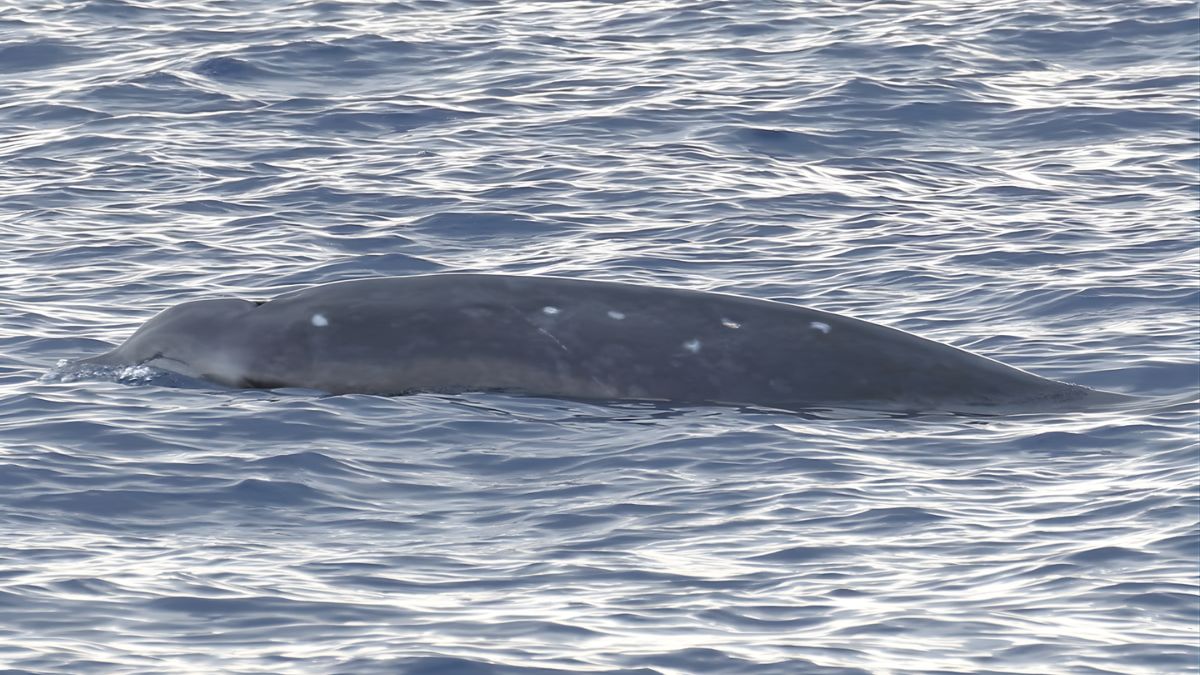
Some discoveries take decades to unravel—and when they finally do, it feels like science fiction becoming fact. That’s exactly what happened when scientists recently spotted and confirmed the first living ginkgo-toothed beaked whale, a species once thought to be just a ghost of the Pacific.
Known only through dead specimens and scattered DNA fragments, no one had ever seen this whale alive… until now. This incredible moment not only confirmed the creature’s existence but also solved a long-standing oceanic mystery: the source of the BW43 sound.
Table of Contents
Ghost

For years, marine biologists called it the “ghost of the Pacific.” The ginkgo-toothed beaked whale (Mesoplodon ginkgodens) was a legend—only known from a few stranded carcasses on remote beaches and random DNA samples. But no photos, no videos, no reliable sightings.
Despite all the technology, the open sea kept its secret. Scientists knew it existed, but seeing it in action? That was a dream.
Signal
Now let’s talk about BW43. For over a decade, underwater microphones—called hydrophones—had been picking up an unidentified echolocation sound in the North Pacific. The sound didn’t match any known whale species. It was there… just no face to match it with.

Researchers suspected it was coming from a beaked whale. But which one? Without a live encounter, it was all guesswork. The BW43 signal was a whisper from the deep that no one could decode—until now.
Breakthrough
It all came together in June 2024, off the coast of Baja California, Mexico. A small research boat was monitoring the water as it had for five summers in a row. Suddenly, movement. Silhouettes. A group of elusive beaked whales surfaced—just briefly—to breathe.
The team acted fast. Cameras clicked. Hydrophones recorded. Then came the big move: a biopsy dart was launched from a scientific crossbow to collect a tiny skin sample—harmless and approved for research. Moments later, the whales vanished into the depths again.

Then came the confirmation: DNA tests showed it was Mesoplodon ginkgodens. After years of effort, scientists had the proof. There were tears, cheers, and lots of hugging on board. The ghost had finally shown its face.
Proof
And just like that, the BW43 mystery was solved. The sound that had baffled scientists for over a decade? It belonged to the ginkgo-toothed beaked whale.
With photos, audio, and DNA from the exact same moment, researchers had everything they needed to confirm the whale’s identity. The acoustic signal was no longer just an anomaly—it was a living creature’s voice.
Traits
These whales are nothing short of remarkable. Adult males develop two strange, flat, leaf-shaped fangs near the tip of their snout. They don’t use them to eat—instead, they use them in fights with other males, likely over mating rights.
Photos revealed scars and long white marks on their backs, signs of battles fought deep in the ocean. Some had circular wounds from “cookie-cutter sharks”—small predators that take round bites from whales and other sea creatures.
Stealth
So, why had no one seen them alive before? It turns out they’re masters of invisibility. Even though they grow over four meters long, they’re incredibly shy and avoid boats. They also live in extremely remote parts of the Pacific and can dive for over an hour to crushing depths. That’s like trying to find a submarine that doesn’t want to be found.
They surface only briefly to breathe, and then vanish. Unless you’re in the right place at exactly the right time—with hydrophones and patience—you’ll never know they were there.
Impact
This sighting is more than just a cool discovery—it’s a major breakthrough. Now that we know what this whale looks and sounds like, scientists can track it across the Pacific using underwater sound technology. They can map its habitat, estimate population numbers, and monitor threats like noise pollution or fishing.
It also means that beaked whales, which are among the least understood marine mammals, may not stay mysterious forever.
Future
Next up? Perrin’s beaked whale. It’s even more mysterious than the ginkgo-toothed whale. Only six dead specimens have ever been found—and no one has seen one alive. But with advanced hydrophones, smart ocean buoys, and a better understanding of beaked whale behavior, scientists believe it’s only a matter of time.
The ocean is still full of secrets. But with dedication, patience, and a little luck, we’re starting to uncover them—one ghost at a time.
FAQs
What is the ginkgo-toothed beaked whale?
A rare whale species just seen alive for the first time.
What is BW43?
A mysterious whale sound now linked to the ginkgo whale.
How was the whale confirmed?
Through DNA, photos, and recorded sound.
Why was it hard to find?
It lives deep, avoids boats, and rarely surfaces.
What’s next for scientists?
Finding the elusive Perrin’s beaked whale.