What if a part of the Solar System never changed—never moved, never collided, never shifted since the beginning of time? That’s what Princeton University researchers might have found: an ancient, untouched structure deep in the Kuiper Belt that could reshape our entire understanding of how the Solar System formed.
Located over 43 astronomical units (AU) from the Sun, this potential new discovery—called the “inner nucleus”—is so stable and so perfectly in place that it could be a direct remnant of the Solar System’s birth.
Table of Contents
Kuiper

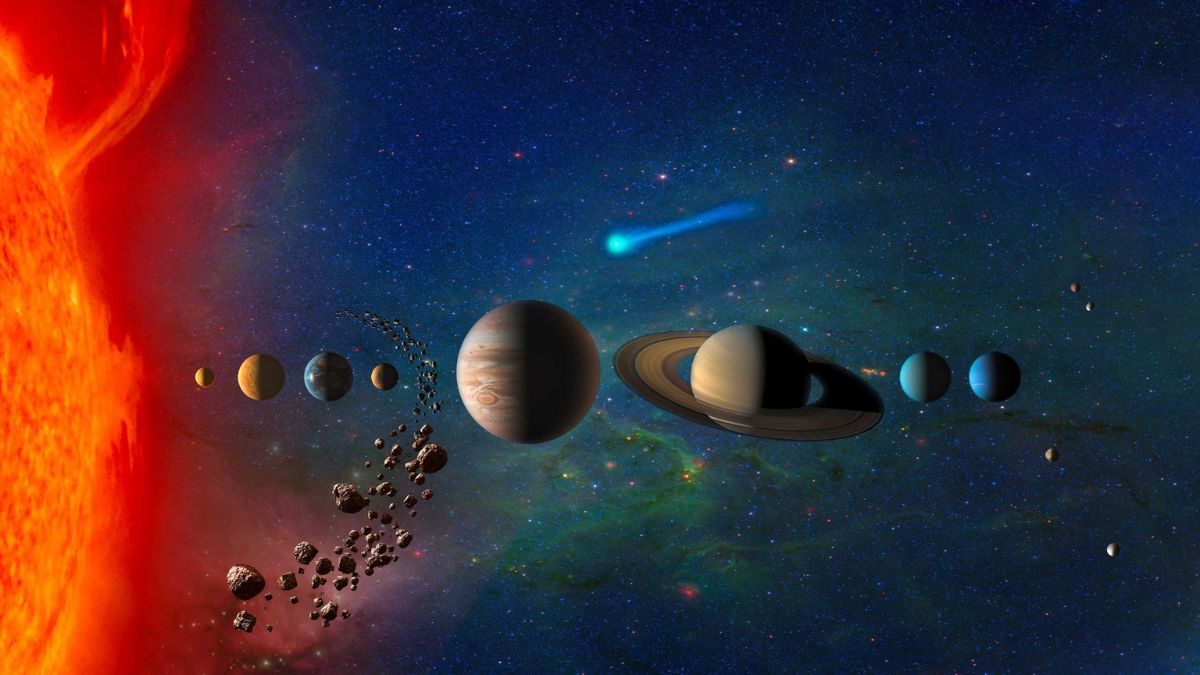
First, a little background. The Kuiper Belt is a vast, icy region beyond Neptune, stretching roughly from 30 AU to 50 AU from the Sun. Think of it as a kind of cosmic junkyard—or, more accurately, a frozen museum. It’s filled with dwarf planets like Pluto, Makemake, and Eris, along with countless small icy bodies called transneptunian objects (TNOs).
NASA even calls this the “third zone” of the Solar System. But for astronomers, it’s more than just a region—it’s a time capsule.
Kernel
Back in 2011, astronomers spotted something weird in the Kuiper Belt: a group of TNOs with extremely circular orbits—a stable ring that became known as the kernel.

Their orbits suggested something strange. These weren’t chaotic leftovers tossed around by gravity. They were calm, cold, and untouched. Something had protected them.
Now, in 2024, scientists from Princeton have analyzed over 1,650 TNOs using a clustering algorithm called DBSCAN. And they didn’t just confirm the kernel—they found something even deeper and more stable: a second structure they’re calling the “inner nucleus.”
Inner
So what is this inner nucleus? It’s a grouping of objects with extremely low eccentricity orbits—between 0.01 and 0.06, which is nearly perfect. That means their paths around the Sun are almost perfect circles. No collisions. No disruptions. No gravitational drama.
It’s like they’ve been sitting quietly at the edge of our Solar System, watching everything else change for over 4 billion years.
Primordial
What if this inner nucleus is a primordial structure? Scientists are buzzing with that idea. If these objects truly formed there—and not elsewhere—and remained undisturbed, they could be older than any planet. In other words, we might be staring at the raw materials from which the Solar System was built.
Another theory? It could be due to Neptune’s “jumping migration”—a theory that says Neptune moved through the Solar System in quick, powerful shifts that shaped everything around it. That model already explained the kernel, and now it could explain this inner nucleus too.
Still, big questions remain.
Uncertain
Is this inner nucleus really a separate group, or just part of the kernel? Are we seeing a distinct formation—or just a statistical blip in a huge data set?
Even the Princeton researchers are cautious. They’ve got compelling evidence, but they admit it’s too early to make a definitive claim. Still, among astronomers, the excitement is real. If proven, it would be one of the most important findings about the outer Solar System in decades.
Rubin
The key to confirming this? The upcoming Legacy Survey of Space and Time (LSST) at the Vera C. Rubin Observatory in Chile. This groundbreaking project will scan the sky in unprecedented detail, tracking fainter and more distant TNOs than ever before.
It will precisely map their orbits and could finally prove—or disprove—whether the inner nucleus is a unique, stable structure. And if it exists? Rubin will find it.
Meaning
If confirmed, the implications are huge. It would give astronomers a clearer picture of how the Solar System evolved, how planets migrated, and how much of that early chaos shaped what we see today.
Even more exciting? It would open the door to finding other untouched zones—primordial fossils of our cosmic history.
Opportunity
This could be a once-in-a-generation opportunity. Imagine being able to study a piece of the universe that has been frozen in time since before Earth even existed. It’s like finding a sealed vault from the beginning of everything—and finally having the key.
We might be able to know not just our system’s past, but other planetary systems as well.
Legacy
The discovery of a cold, calm, perfectly preserved group of objects might not sound thrilling to everyone—but in astronomy, it’s the equivalent of finding the Rosetta Stone of planetary formation.
Now we wait. Will the Rubin Observatory confirm it? Will we rewrite our textbooks? Or will the inner nucleus fade into theory?
Whatever happens, one thing is clear: the outer Solar System just got a whole lot more interesting.
FAQs
What is the inner nucleus?
A newly identified group of ultra-stable objects beyond Neptune.
Where is the inner nucleus located?
Around 43 AU in the Kuiper Belt, beyond Neptune.
How was it discovered?
By analyzing 1,650 objects using the DBSCAN algorithm.
Why is it important?
It may be a primordial structure from the Solar System’s origin.
What could confirm it?
The Vera Rubin Observatory’s LSST will help confirm or disprove it.