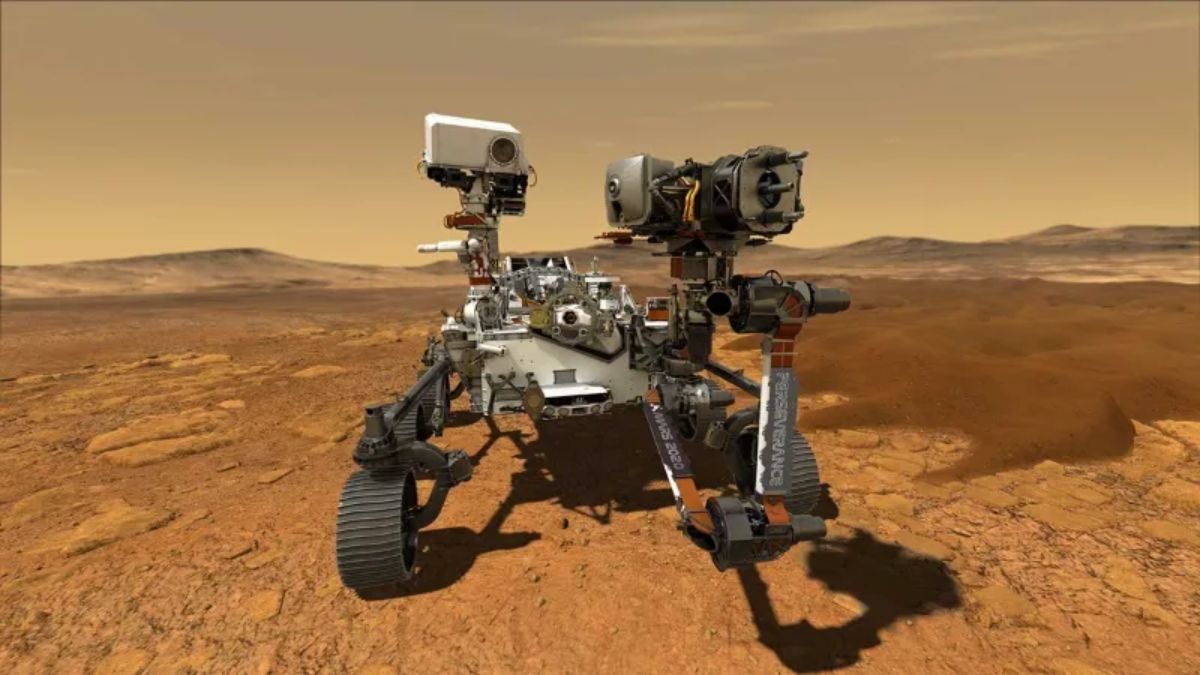
Mars never stops surprising us, and this time, it’s thanks to NASA’s Perseverance rover. After more than five years looking into the surface of the Red Planet, this robotic explorer has made a major discovery: a strange rock that doesn’t seem to belong on Mars at all. Found in the Jezero Crater, this unusual formation is rich in iron and nickel—two elements that suggest it may have fallen from space.
So what’s the deal with this alien rock? Let’s break it down.
Table of Contents
Discovery

The Perseverance rover discovered the odd-looking rock in a region called Vernodden inside Jezero Crater. Scientists have named it Phippsaksla, and it’s nothing like the other rocks in the area.
This particular rock caught the rover’s attention due to its unusual size, shape, and texture. It’s roughly 80 centimeters wide, sits higher than its surroundings, and has a sculpted surface that looks totally different from the Martian terrain around it.
What makes it stand out most, though, is its composition.
Composition

Phippsaksla contains large amounts of iron and nickel, which is rare on Mars. Most Martian rocks are volcanic or sedimentary, but this one seems to be an iron-nickel meteorite—a type of rock that forms in the core of ancient asteroids.
These meteorites are formed when heavier elements like iron and nickel sink to the center of large asteroids during the early days of our solar system. Over billions of years, some of these space rocks break apart and travel through space—until one crashes onto a planet like Mars.
So yes, this rock may actually be a visitor from deep space.
Analysis

How did scientists figure all this out? Enter Perseverance’s SuperCam—a powerful tool equipped with lasers and spectrometers. It can study rocks by shooting them with lasers and analyzing the light that bounces back. That light tells scientists exactly what elements are in the rock.
SuperCam confirmed the presence of iron and nickel, pointing strongly toward the meteorite theory.
Plus, the rover’s Mastcam-Z cameras snapped high-definition images of Phippsaksla from both close range and long distance, showing its odd texture and position.
Sampling
The Perseverance rover doesn’t just look at rocks—it can also drill into them and perform mini-lab tests on the spot. While it can’t bring samples back to Earth itself, it can prepare and store them for a future mission to collect.
If scientists decide that Phippsaksla is worth further study, they could tag it for Mars Sample Return—a joint project in the works between NASA and the European Space Agency.
Here’s a quick look at the rover’s tools used in this discovery:
| Tool | Function |
|---|---|
| SuperCam | Analyzes chemical composition with lasers |
| Mastcam-Z | Captures high-resolution images |
| Drill system | Extracts rock samples |
| Onboard lab | Conducts mini experiments on Mars |
Importance
Meteorites like Phippsaksla are rare, but not completely new. Mars has been hit by space rocks for billions of years. What makes this finding so special is its location and the fact that Perseverance had never found one like this in Jezero Crater before.
This discovery helps scientists:
- Understand how Martian geology interacts with space debris
- Compare Martian meteorites with those found on Earth
- Learn about early solar system materials
Each alien rock like this offers new clues about the history of Mars—how it formed, how it’s changed, and what it’s made of.
Achievements
Let’s not forget how much Perseverance has already accomplished. Since landing in February 2021, this rover has been a real overachiever. Some of its top milestones include:
- Traveling across ancient lake beds
- Finding rocks shaped by water
- Studying volcanic formations
- Searching for past signs of microbial life
- Setting the record for the longest distance driven on another planet
And the mission isn’t over yet. In fact, there’s no official end date, which means Perseverance will keep rolling, snapping, drilling, and discovering for years to come.
Every new rock tells a story—and Phippsaksla might just be one of the most exciting chapters yet.
With tools that rival a full science lab, this rover continues to uncover Mars’ deepest secrets. Who knows what it’ll find next? One thing’s for sure—this mission is far from over, and the surprises are just getting started.
FAQs
What is the Phippsaksla rock?
It’s an iron-nickel meteorite found on Mars by the Perseverance rover.
Where was it found?
It was found in the Vernodden area of Jezero Crater on Mars.
Why is the rock special?
Its iron-nickel makeup suggests it’s not native to Mars.
How was it studied?
Using lasers and spectrometers from the rover’s SuperCam.
Can the rock be brought to Earth?
Not by Perseverance, but future missions may collect it.