What if everything we know about the universe is backwards? That’s exactly what physicist Gunther Kletetschka from the University of Alaska Fairbanks is suggesting. In a bold new theory, he claims time isn’t a straight line—it’s three-dimensional. And more than that, space might not even be fundamental. Instead, it could be a result of time itself folding and interacting.
Sounds like something straight out of science fiction? Maybe. But this theory is real, peer-reviewed, and could shake the foundations of modern physics—just like Einstein’s ideas did a century ago.
Table of Contents
Framework

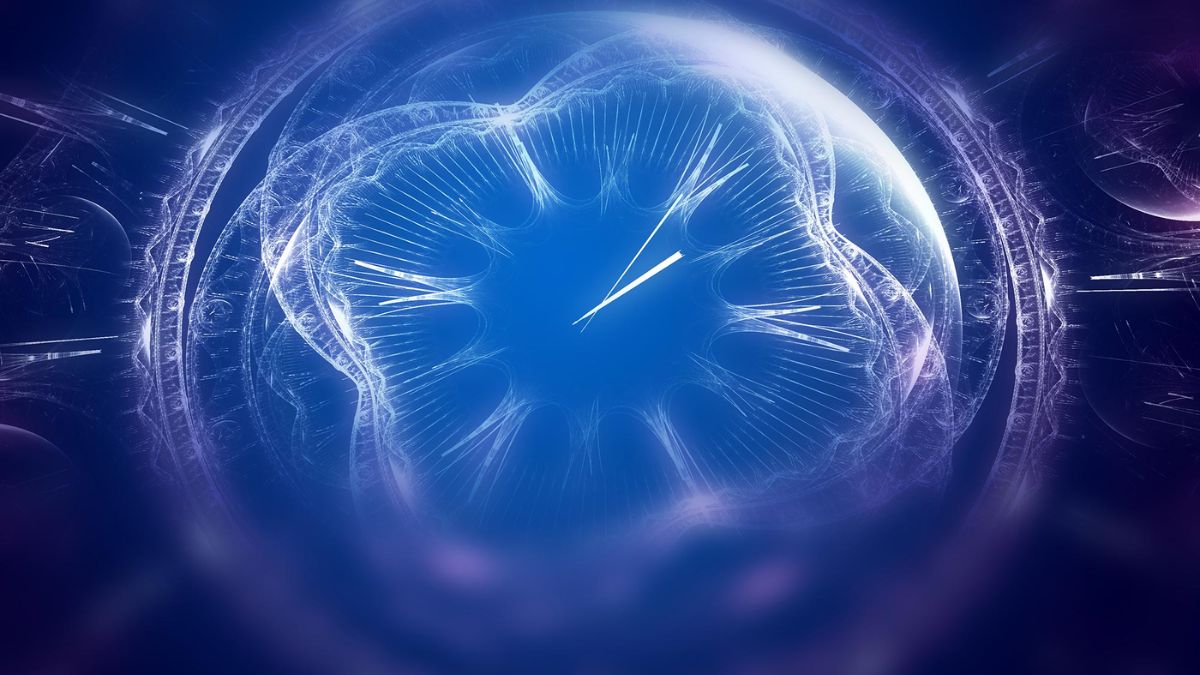
Let’s break this down. Kletetschka proposes that the universe isn’t built from space and time, as Einstein’s relativity model suggests. Instead, it’s made entirely of time—three axes of it. Think of it like a braid of temporal strands twisting and shaping everything: matter, motion, gravity, even the space we think we’re in.
In this model, every physical event—like a planet orbiting the sun or a subatomic particle moving—isn’t really happening “in space.” It’s happening inside a three-dimensional temporal framework.
Each of the three time axes interacts with the others. That interaction creates what we perceive as energy, mass, or motion. If this theory holds up, it could explain things current physics can’t—like why particles have mass, or how time itself behaves on the quantum level.
Illusion

Einstein famously taught us that space and time are part of a single fabric—spacetime. But Kletetschka goes a step further. He says space might just be an illusion. Not a trick of the eye, but a byproduct of our perception of time’s threefold structure.
If he’s right, then everything in the universe—from galaxies to atoms—doesn’t exist in space. Instead, they emerge from time.
It’s like thinking we’re living on a stage, only to discover the stage is just an effect of the lights and sound. Space isn’t the set—it’s the echo of time’s deeper dimensions.
Meaning
So what does this mean? If time is the real fundamental fabric, it could be the missing link between the two major pillars of physics: relativity (which deals with massive objects) and quantum mechanics (which handles the tiniest particles). Right now, these two theories don’t play well together. But a three-dimensional time model might be the bridge scientists have been looking for.
And beyond that? Well, knowing time at this level could unlock unimaginable technologies—like new forms of communication, or even ways to manipulate time itself.
Reception
Of course, the scientific community is approaching the theory with cautious curiosity. Groundbreaking ideas always get scrutinized, and that’s how science works. But Kletetschka has already published his work, titled “Three-Dimensional Time: A Mathematical Framework for Fundamental Physics,” and it’s gaining traction in academic circles.
It’s early days, but many scientists see potential in the idea. It could finally resolve contradictions that have puzzled physicists for decades.
Perspective
The concept of three-dimensional time flips our knowing of reality. If true, time doesn’t just pass—it surrounds us. We don’t simply move through time—we exist within it, in all directions.
Here’s a quick visual comparison of both views:
| Traditional View | Kletetschka’s Theory |
|---|---|
| Space and time are a single fabric | Time has 3 dimensions; space is secondary |
| Space is the arena, time passes | Time is the arena; space is an effect |
| Universe exists in space | Universe emerges from time |
| Time is linear | Time is multidimensional and braided |
If Kletetschka’s theory is ever confirmed, it would change physics forever. His name could one day sit next to Einstein, Newton, and Hawking.
In this new model, we’re not travelers in time—we’re part of it. Every particle, every star, even you and me—we might just be shadows cast by time moving in three dimensions.
Now that’s a plot twist the universe never saw coming.
FAQs
Who is Gunther Kletetschka?
A physicist from the University of Alaska Fairbanks.
What does his theory suggest?
That time has 3 dimensions and space is its byproduct.
Is space real or an illusion?
According to this theory, space is a result of time.
Can this theory replace relativity?
It could unite relativity with quantum mechanics.
Has the theory been published?
Yes, in a paper titled ‘Three-Dimensional Time’.