What if the silent sands of Egypt could speak? Well, they just did—loud and clear. Deep in the Wadi Desert, scientists have uncovered something that completely changes what we thought we knew about crocodile evolution: the fossil of a four-meter-long marine crocodile with a bizarre snout and crushing bite. Say hello to Wadisuchus kassabi, a terrifying aquatic predator from 80 million years ago.
This discovery doesn’t just reveal a new species. It suggests that Africa, not Asia or the Americas, was the true birthplace of ancient marine crocodiles. That’s a massive shift in the evolutionary story of one of Earth’s oldest reptilian dynasties.
Table of Contents
Fossil

The fossils were unearthed in Egypt’s Kharga and Baris oases, now dry desert zones that were once lush tropical plains and coastlines. Scientists from the Mansoura University Vertebrate Paleontology Center (MUVP) found remains from four different individuals, offering a rare glimpse at various life stages of this ancient beast.
Using digital scanning and 3D reconstruction tech, researchers pieced together what the animal would have looked like—and let’s just say you wouldn’t want to be in the water with it.
Predator
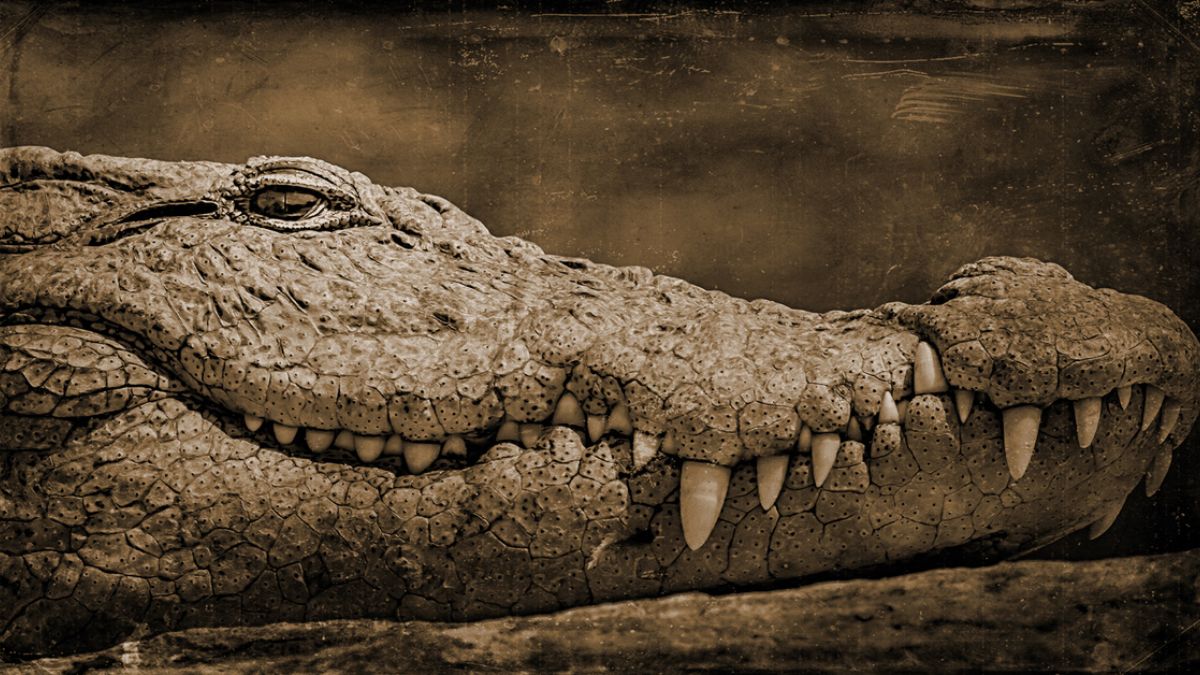
Wadisuchus kassabi was between 3.5 to 4 meters long, fully aquatic, and built for speed and power. It had:
- A shorter, compact snout
- Only four front teeth (fewer than its relatives)
- Nostrils on top of its snout (like modern whales and marine crocodiles)
- A grooved jawline, hinting at a bite strong enough to crush shells and carapaces

It didn’t just catch fish—it dominated the coastal waters of ancient Africa.
| Feature | Description |
|---|---|
| Length | 3.5 to 4 meters |
| Teeth | Needle-like, sharp, fewer in number |
| Snout | Compact and uniquely shaped |
| Lifestyle | Fully aquatic, agile swimmer |
| Bite Strength | Powerful, able to crush hard shells |
Link
This species is being hailed as the missing evolutionary link between land-based crocodiles and the fully marine dyrosaurids—a group of sea crocs that even survived the mass extinction that wiped out the dinosaurs.
Its existence pushes back the evolutionary timeline for marine crocodiles by seven million years, which is huge in paleontological terms. And it roots that origin story firmly in Africa.
Origins

For decades, scientists believed marine crocodiles evolved elsewhere—maybe in Asia or the Americas. But Wadisuchus kassabi flips that idea on its head.
“Marine crocodiles didn’t start in Asia or America. Their story began here, in Africa.”
And from there, the descendants of Wadisuchus eventually spread to Europe, the Americas, and beyond. It’s a major win for African paleontology, proving the continent’s role as a cradle of evolution for more than just humans.
Name
The name Wadisuchus kassabi is packed with meaning:
- “Wadi” refers to the desert valley where it was found
- “Suchus” comes from Sobek, the ancient Egyptian crocodile god
- “Kassabi” honors Ahmed Kassab, a pioneering Egyptian paleontologist
It’s a nod to both ancient mythology and modern science—and a reminder of Egypt’s growing importance in global fossil research.
Risk
But there’s a problem. Many fossil-rich areas in Egypt are under threat from urban development and farming. Researchers are calling for these zones to be protected before it’s too late.
“Each lost fossil is a story we’ll never be able to tell again,” said MUVP’s Salem.
With so much of Earth’s history still hidden beneath the sand, losing even one site could mean the permanent erasure of an entire chapter of evolution.
Impact
The discovery of Wadisuchus kassabi is more than just a cool fossil. It changes:
- Where we believe marine crocodiles originated
- When they started evolving
- How they adapted to marine life
- And who gets credit for major evolutionary milestones
Africa is finally taking center stage in the story of ancient reptiles—and this find is just the beginning.
FAQs
What is Wadisuchus kassabi?
A newly discovered ancient marine crocodile species from Egypt.
How old is this species?
It lived about 80 million years ago in the Cretaceous period.
Where was it found?
In Egypt’s Wadi Desert, at Kharga and Baris oases.
Why is it important?
It’s the oldest known ancestor of marine crocodiles.
What threatens future discoveries?
Urban and agricultural expansion may destroy fossil sites.