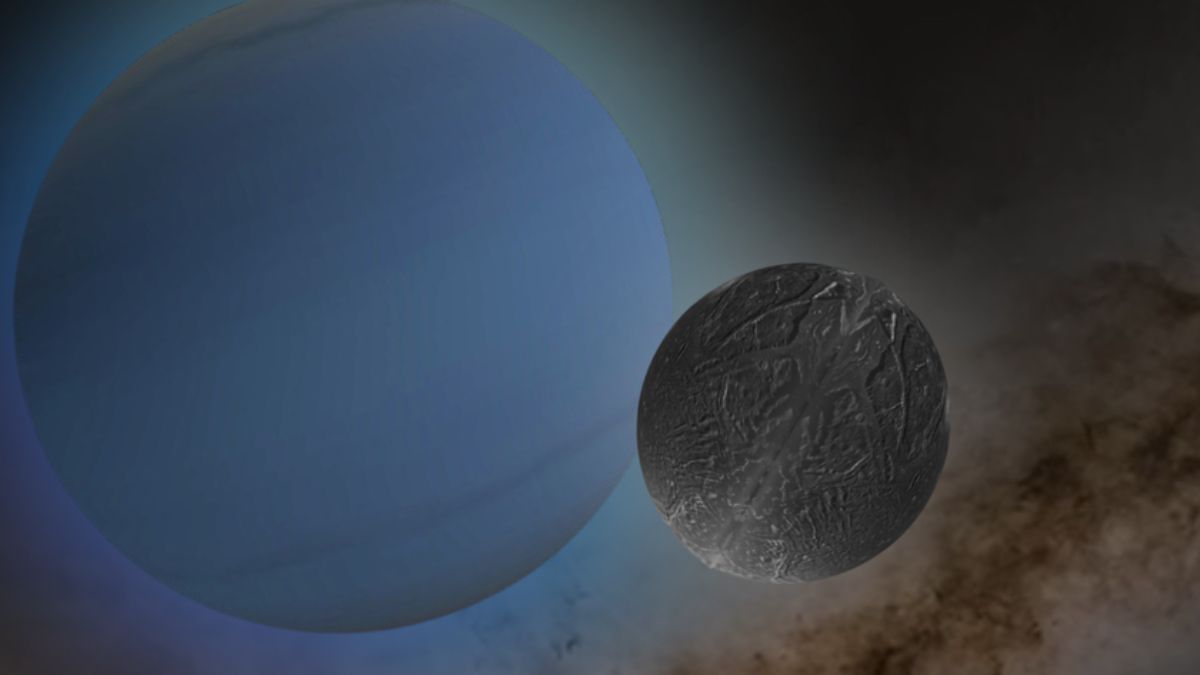
A surprising discovery is shaking up what we thought we knew about the outer planets. Astronomers from NASA and the SETI Institute have confirmed a new moon orbiting Uranus, and it’s doing something strange—exhibiting unusual gravitational behavior.
Even more mind-blowing? This moon, called S/2025 U1, has been hiding in plain sight for nearly 40 years. It was even there when Voyager 2 flew by Uranus in 1986. So, how did everyone miss it? And why does this little moon matter so much?
Table of Contents
Discovery

Let’s start with the basics. S/2025 U1 is a small satellite—only about 10 kilometers across. That’s tiny in cosmic terms, more like a speck of dust compared to other moons. But what makes it fascinating isn’t its size, it’s how it stayed hidden for decades. This moon orbits within Uranus’ ring system, an area full of particles and debris that make spotting anything in there extremely hard.
For years, the data sat in front of us. But the moon remained invisible, not because it wasn’t there, but because our tools just weren’t good enough to see it clearly. Voyager 2 did its best back in 1986, but with camera technology that’s ancient by today’s standards, it simply couldn’t pick out the faint, fast-moving object hidden in the shadows of Uranus’ rings.
Breakthrough
Enter the James Webb Space Telescope. This space marvel, with its cutting-edge tech and eye for detail, is changing the game. Led by researcher Maryame El Moutanid, a team used Webb to study Uranus in detail—and there it was. A tiny flicker of movement, almost invisible. But it was real.

Thanks to its infrared capabilities and precision imaging, Webb caught what Voyager could not. And just like that, a 40-year mystery was solved.
Behavior
So what’s the big deal about a 10-kilometer moon? Surprisingly, a lot. S/2025 U1 isn’t just spinning in circles. It’s influencing the space around it in unexpected ways. Scientists believe it might be a “shepherd moon”—a type of moon that helps shape and maintain the structure of planetary rings.
Imagine a sheepdog guiding a flock. That’s what shepherd moons do with ring particles. They control their movement, define edges, and keep things from scattering. If S/2025 U1 is doing this, it might mean the ring system of Uranus isn’t chaotic at all—it could be finely tuned and structured.
Here’s a quick look:
| Feature | Details |
|---|---|
| Name | S/2025 U1 |
| Size | ~10 kilometers in diameter |
| Orbit Location | Within Uranus’ ring system |
| Discovered By | James Webb Space Telescope |
| Behavior | Possible shepherd moon |
| Hidden Since | Voyager 2 flyby in 1986 |
Impacts
The discovery could rewrite parts of our solar system’s story. Until now, Uranus’ rings were considered mostly disorganized, just leftover debris. But this moon hints at something deeper—structure, purpose, and perhaps a rich history that’s still being uncovered.
And if one hidden moon can remain undetected this long, how many more could be out there?
Astronomers are already suggesting that there could be several more tiny moons within the rings. Some might be shaping the ring system just like S/2025 U1. If that’s true, then our entire understanding of how Uranus’ rings formed, evolved, and behave may be wrong—or at least incomplete.
Simulations
Right now, NASA is putting supercomputers to work to simulate this moon’s past. Where did it come from? Is it a fragment of a larger body? Was it born from the rings themselves? Or is it something even more exotic, like a captured object from beyond the planet?
By modeling its orbit, speed, and gravitational effects, researchers hope to trace its history—and maybe even predict its future. One thing’s certain: this moon is tiny, but it’s not insignificant.
Curiosity
Astronomy thrives on curiosity. You might wonder, are scientists going too far trying to learn about something so small? Maybe. But history shows us that even the tiniest discoveries can flip our understanding of space on its head.
Think of Pluto—it started as a dot. So did every exoplanet. Black holes were once a theory, now they’re headlines. In the vastness of the universe, small things often have big stories to tell.
Urgency
This new moon has sparked calls for a dedicated mission to Uranus. Telescopes, even powerful ones like Webb, can only do so much from afar. A spacecraft, orbiting or even landing on Uranus’ moons, could unlock secrets that would otherwise take decades to uncover.
And who knows—S/2025 U1 might be just the beginning.
What else is hiding in the cosmic shadows? What other truths have we missed while staring into space with old tools and tired models? The universe still has secrets, and it looks like we’re just getting started.
Uranus’ new moon might be small, but its impact could be huge. It reminds us how little we truly know—and how exciting that is.
FAQs
What is S/2025 U1?
A newly discovered moon orbiting Uranus, hidden for 40 years.
Why wasn’t it seen before?
It was too small and dark, hiding within Uranus’ rings.
Who discovered the moon?
It was confirmed using the James Webb Space Telescope.
What is a shepherd moon?
A moon that shapes and controls planetary rings.
Will there be a mission to Uranus?
Scientists are calling for one after this discovery.