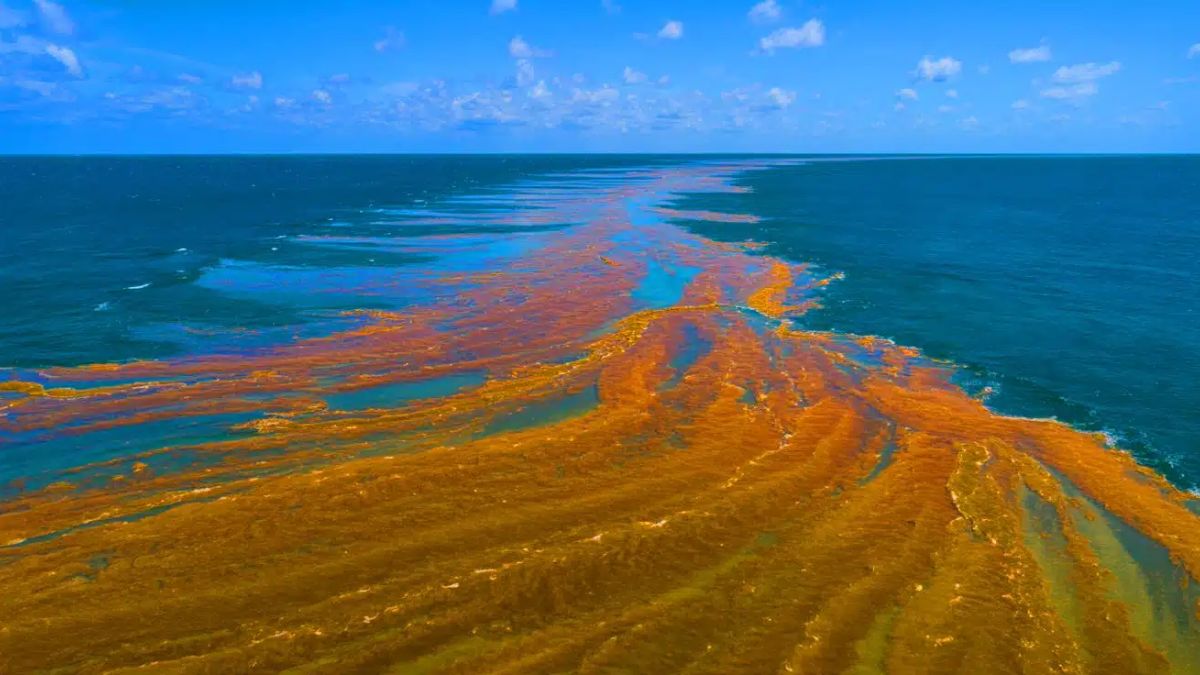
There’s something unusual brewing in the Atlantic Ocean — and it’s not a small issue. A massive stretch of brown algae, known as the Great Atlantic Sargassum Belt, is rapidly growing across the sea.
Once a rare occurrence, it has now become a recurring ocean event, so big it can be seen from space. While it may just look like harmless seaweed, the truth is, it’s turning into one of the most pressing marine problems of our time.
Table of Contents
Sargassum

So, what is this all about? The Sargassum Belt is made up of floating brown algae called sargassum. It naturally occurs in the Sargasso Sea, a region in the middle of the Atlantic. There, it plays an important role in marine life.
But things have changed.
Over the past 15 years, this algae has spread way beyond its traditional zone. It now stretches more than 8,800 kilometers — that’s over twice the width of the continental U.S. In May 2025, satellite images confirmed a staggering 37.5 million tons of it floating across the ocean.
Growth
Scientists have been tracking this development closely. A study published in the journal Harmful Algae reveals that since 2011, these blooms have been growing almost every year. What’s behind this explosive growth?
The answer is in the water.
Between 1980 and 2020, nitrogen levels in the sargassum increased by 55%, while nitrogen and phosphorus concentrations grew by 50%. These spikes are mostly caused by:
- Runoff from farms (fertilizers and pesticides)
- Untreated sewage and wastewater
- Pollution from the air (atmospheric deposits)
And one of the biggest contributors? The Amazon River. During its rainy seasons, it floods nutrient-rich freshwater into the Atlantic, basically feeding this algae. When the river flow slows during dry periods, the blooms decrease.
Threats
At low levels, sargassum is helpful. It offers shelter and food to more than 100 species, including turtles and fish. The National Oceanic and Atmospheric Administration (NOAA) even calls it a critical marine habitat.
But in massive amounts, it flips from hero to villain.
Here’s what happens when sargassum becomes excessive:
- It releases hydrogen sulfide gas as it rots — smells like rotten eggs and is toxic to humans.
- It blocks sunlight, damaging coral reefs and underwater plants.
- It steals oxygen from the water, creating “dead zones” where marine life can’t survive.
- It emits methane and other greenhouse gases, pushing the climate crisis further.
Impact
This isn’t just an environmental problem — it hits people hard too.
Coastal communities across the Caribbean, Gulf of Mexico, and Florida know all too well how much damage sargassum can do. Each summer, beaches are buried under thick, smelly mats of seaweed. Tourists cancel trips. Hotels lose money. Local fishermen suffer.
The cleanup costs are staggering. Millions are spent removing this algae year after year. And it doesn’t stop there. Back in 1991, a major sargassum bloom was so intense it shut down a nuclear plant in Florida — the seaweed clogged the cooling system’s water intake.
Currents
Ocean currents like the Gulf Stream help transport this massive floating belt from Africa’s west coast all the way to the Americas. That’s why the belt spans such a wide area and affects so many regions.
This isn’t just a local issue anymore. It’s global.
Scientists agree: if we don’t take serious steps soon, the problem will spiral. Pollution needs to be reduced, wastewater treatment must be improved, and predictive systems should be developed to warn coastal areas in advance.
Change
The Great Atlantic Sargassum Belt is more than just seaweed. It’s a sign that Earth’s ocean systems are being altered. What started as a natural algae patch has morphed into a full-blown crisis — driven by human activity, climate change, and unchecked pollution.
The takeaway? We can’t ignore it anymore. Whether you live near a beach or thousands of miles away, this floating belt affects you. From the climate to marine life to the economy, its reach is deep and wide. The ocean is sending us a message. The only question is: will we listen?
FAQs
What is the Sargassum Belt?
A massive stretch of floating brown algae in the Atlantic.
How long is the algae belt?
It stretches over 8,800 kilometers across the Atlantic.
What causes sargassum to grow?
Fertilizers, sewage, Amazon runoff, and air pollution.
Why is sargassum a problem?
It releases toxic gases and harms marine ecosystems.
How does it affect people?
It impacts tourism, fishing, and causes costly cleanups.