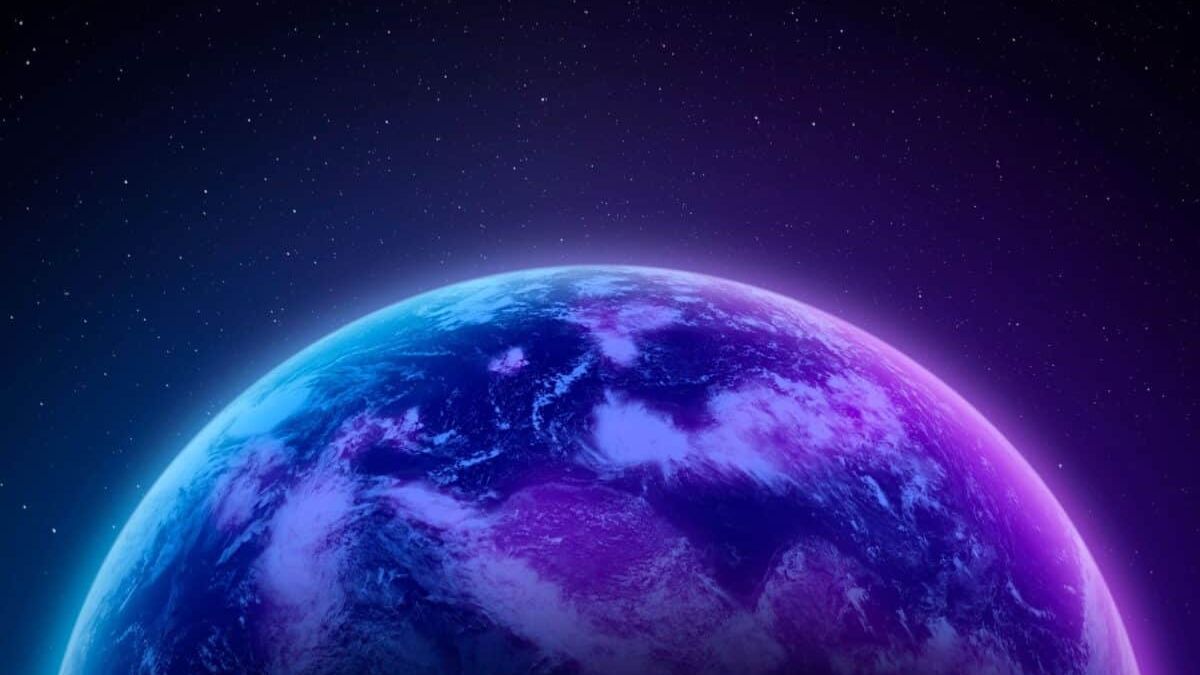
When we think of Earth, we picture blue oceans and green forests. But what if the Earth wasn’t always like that? According to a theory backed by NASA-linked scientists, our planet might have once glowed with a deep purple hue. That’s right—before oxygen, trees, and grass, Earth could have been a giant purple ball floating in space.
This idea, known as the Purple Earth Hypothesis, suggests that early life used a different light-absorbing molecule than modern plants. Let’s cut into how this works—and how the Earth could even turn purple again one day.
Table of Contents
Retinal

The theory comes from the work of Dr. Edward Schwieterman from the University of California, Riverside, and Professor Shiladitya DasSarma from the University of Maryland. Both are researchers with ties to NASA and are deeply involved in the study of early Earth and extraterrestrial life.
They focused on a molecule called retinal. This compound can capture sunlight and convert it into energy, just like chlorophyll does in plants. But there’s a twist.
Retinal absorbs green light and reflects red and blue light. When those two colors mix, the result is—you guessed it—purple. So, if retinal-based life covered much of the planet billions of years ago, Earth would have looked violet or purple from space.
Archaea
Back then, Earth was a very different place. There were no forests, no animals, and certainly no humans. The only life forms were tiny microorganisms known as archaea. One example is the halobacterium, which still exists today in very salty places like the Dead Sea.
These archaea didn’t use chlorophyll. Instead, they used retinal to absorb sunlight and create energy. This early version of photosynthesis didn’t produce oxygen but worked just fine for these primitive life forms.
Scientists believe that, since these organisms could have existed in large numbers, they may have painted Earth in a violet glow—forming the Purple Earth.
Oxygen
Everything changed around 2 billion years ago during the event known as the Great Oxygenation Event (GOE). This was when new types of organisms evolved, using chlorophyll instead of retinal. Their photosynthesis process produced oxygen as a byproduct.
As these new organisms multiplied, they released massive amounts of oxygen into the atmosphere. This oxygen-rich environment allowed more complex life—like plants and animals—to evolve.
And with the rise of chlorophyll-based life, Earth shifted from a purple world to the green and blue planet we know today.
Future
Now here’s the wild part—could Earth become purple again?
It sounds like science fiction, but researchers say it’s possible. If something ever caused Earth’s oxygen levels to drop significantly—maybe due to climate change, a mass extinction, or major environmental collapse—chlorophyll-based life could decline.
In such conditions, retinal-based organisms might rise again, spreading across the planet like they once did. Earth could slowly return to its ancient purple state.
Of course, this would take a long time and major changes to the atmosphere. But the fact that it’s even possible shows just how dynamic and adaptable life on Earth can be.
Exoplanets
What’s even more exciting is that this idea may help scientists search for life on other planets.
With modern telescopes, scientists can now detect the light reflected by exoplanets—planets outside our Solar System. If they ever spot purple tones in a planet’s light signature, it could be a clue that life is present—and not the kind we usually expect.
This has led NASA and other researchers to look beyond just Earth-like green signs of life. Purple planets could be hiding living organisms based on retinal, just like early Earth may have had.
Here’s a quick comparison of the two types of molecules:
| Feature | Chlorophyll | Retinal |
|---|---|---|
| Light Absorbed | Red & blue | Green |
| Light Reflected | Green | Red & blue (appears purple) |
| Produces Oxygen? | Yes | No |
| Life Forms Today | Plants, algae | Archaea (in salty places) |
| Possible on Exoplanets? | Yes | Yes |
Perspective
The Purple Earth Hypothesis is still just a theory, but it offers a fascinating new look at the past—and the future—of life on our planet. It also opens our minds to what life might look like elsewhere in the universe.
Life didn’t always look the way it does now. Earth has worn different colors, hosted different organisms, and gone through radical transformations over billions of years.
And who knows? If conditions change again, maybe purple will be Earth’s color of the future.
FAQs
What is the Purple Earth Hypothesis?
It suggests Earth was once covered in retinal-based life, making it look purple.
What is retinal?
A molecule that absorbs green light and reflects purple tones.
Did retinal organisms produce oxygen?
No, unlike chlorophyll, retinal doesn’t release oxygen.
Can Earth turn purple again?
Yes, if oxygen levels drop, retinal life could return.
Could purple planets have life?
Yes, purple light may signal retinal-based life on exoplanets.