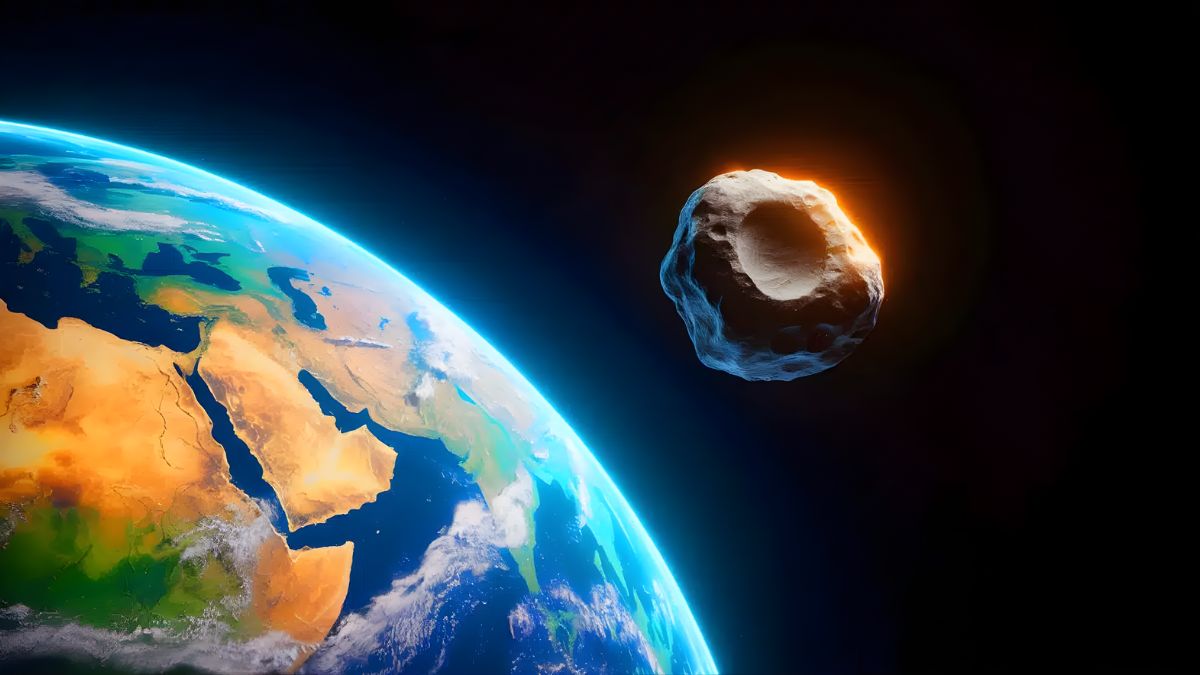
Space just gave us another surprise. On October 1, 2025, a small asteroid passed incredibly close to Earth—so close it actually flew through the region where many satellites orbit and where the International Space Station (ISS) circles the planet. The kicker? We didn’t even know it was there until it was already gone.
The asteroid, named 2025 TF, wasn’t dangerous, but it sure was a wake-up call. Measuring just 3 meters wide—about the size of a car—it came within 428 kilometers of Earth. That’s lower than many satellites and nearly the same altitude where astronauts live aboard the ISS. Let’s break down what happened and why it matters.
Table of Contents
Flyby

At exactly 00:47:26 UTC, above Antarctica, asteroid 2025 TF zipped by our planet at a dangerously close distance—just 428 kilometers from Earth’s surface. To give that some context, the ISS orbits at altitudes between 370 and 460 kilometers. That means this little rock was practically brushing the same space highway used by human space missions.
Despite the near miss, it passed without incident and without anyone even noticing—until it was already long gone.
Visitor
Now before you start imagining Hollywood-style asteroid disasters, it’s important to know this asteroid posed no real threat. It was between 1 to 3 meters in size, which means even if it had hit Earth, it would have disintegrated in the atmosphere. At worst, it might have lit up the Antarctic sky in a beautiful fireball before burning up completely.

Maybe a small fragment would have made it to the snowy surface, but nothing more. No explosion, no impact crater—just a short-lived light show.
Delay
Here’s the wild part: nobody saw it coming.
The first detection of 2025 TF came six hours after its closest approach. The credit goes to the Kitt Peak-Bok Observatory in Arizona, which spotted it at 06:36 UTC. Later, astronomers reviewed older data and found that the Catalina Sky Survey had also captured it around two hours after its closest approach—but didn’t realize it at the time.
This shows how tough it is to track these kinds of small, fast-moving space rocks. They’re dark, faint, and don’t reflect much light, which means telescopes can easily miss them until it’s too late.
Future
After its unexpected close encounter, 2025 TF just kept cruising through space. According to NASA’s Jet Propulsion Laboratory (JPL), the next time it swings by Earth will be in April 2087. The good news? It won’t be anywhere near this close.
That time, it will pass at a distance of about 8 million kilometers, which is roughly 21 times the distance between Earth and the Moon. So no close calls, no surprises—just a quiet visitor in the sky.
Lessons
Even though 2025 TF wasn’t a danger, its flyby highlights something important: we’re constantly being visited by space objects, and many of them are undetected until the last moment. While most of these are harmless and burn up in the atmosphere, the concern is always out there—what if a bigger one sneaks up on us?
That’s why scientists around the world are improving asteroid tracking systems, using new technology, better telescopes, and even planning future space missions to intercept and study these rocks.
Wonder
Space is full of mysteries, and while we go about our daily lives here on Earth, things are happening out there—huge things, strange things, unexpected things. One tiny asteroid just flew past Earth closer than our satellites, completely unnoticed until hours later. That’s a reminder of how small we really are, and how amazing the universe around us truly is.
Every observation like this one helps us learn more about our solar system, about asteroid behavior, and about how to stay safe in the long run. Because one day, a rock might come along that’s not so tiny—and we’ll want to be ready.
FAQs
How big was asteroid 2025 TF?
Between 1 and 3 meters wide—about the size of a car.
How close did it get to Earth?
Only 428 kilometers—closer than many satellites.
Was it dangerous?
No, it would’ve burned up if it entered Earth’s atmosphere.
When was it detected?
Six hours after it had already passed Earth.
Will it return in the future?
Yes, in April 2087—but from a safe 8 million km away.