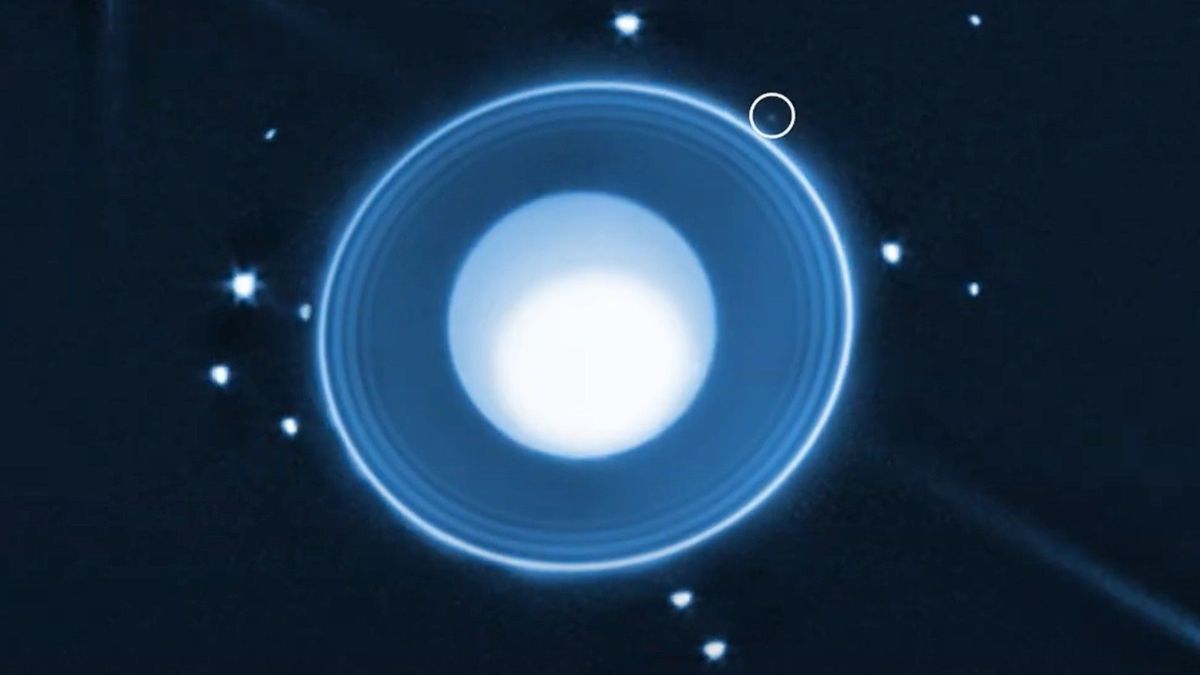
Just when we thought the Solar System had no surprises left, astronomers have discovered a brand-new moon orbiting Uranus — one that had gone unnoticed for nearly 40 years. It’s small, dark, and subtle, but its discovery is redefining our maps of the outer planets and reminding us just how much we don’t know about our cosmic neighborhood.
Say hello to S/2025 U1, the tiny moon that hid in plain sight for decades — and may now reshape what we thought was settled science.
Table of Contents
Hidden

So, how do you miss a moon?
It turns out, it’s easier than you’d think — especially if the moon is just 10 kilometers wide, hidden among bright planetary rings, moving fast and reflecting very little light. This moon was so well-camouflaged that even Voyager 2, which flew past Uranus in 1986, didn’t catch it.
And that’s not a knock on Voyager — at the time, it was revolutionary. But its technology was from the 1980s, and when compared to today’s telescopes, it’s like comparing a flip phone to a smartphone.
Webb

Enter the James Webb Space Telescope.
In 2024, a team led by researcher Maryame El Moutanid pointed Webb’s ultra-sensitive infrared instruments at Uranus. The goal? To explore what Voyager might have missed.
And then it happened — a faint object moved through the data. It wasn’t random space debris. It was something in orbit, circling Uranus in a region where no object had been logged before.
That “something” was a new moon — the first to be discovered around Uranus in decades. And its temporary name? S/2025 U1.
Shepherd
Why is this discovery important?
It’s not just that we found another moon. It’s what this tiny object is likely doing.
Researchers believe S/2025 U1 may be acting as a “shepherd moon” — a type of small satellite that gravitationally sculpts and maintains the shape of planetary rings. Saturn is known to have a few, and now Uranus might too.
This means Uranus’s rings, once thought to be chaotic or randomly formed, may actually be organized and structured. That’s a major shift in our understanding of the planet — and could mean more tiny, hidden moons are out there.
Mission
Naturally, this finding has reignited calls for a dedicated mission to Uranus. While it’s been visited briefly (by Voyager 2), we’ve never sent a probe into orbit around the planet.
With so many new questions — Where did the moon come from? Is it stable? Is it part of a broken moon? Are there more like it? — scientists are pushing for a mission with modern instruments and a full orbital study.
Until then, simulations will have to do. But they’re already being used to model how S/2025 U1 formed, how it moves, and what its role might be in shaping Uranus’s rings.
Surprise
This discovery also forces a humbling question: What else is hiding in the Solar System?
If a moon — an entire celestial body — could go unnoticed for 40 years, even after a spacecraft flew right by it, how many more are out there?
Are we missing smaller moons? Distant dwarf planets? Entire populations of unknown objects?
The reality is, our tools are improving fast — but we’re still far behind the universe itself. What we consider “known” today may be laughably outdated in just a few years.
Scale
To put this in perspective: S/2025 U1 is just 10 km wide. It’s small, dark, and quiet — and yet, its presence may rewrite how we know Uranus’s entire ring system.
And if that’s true for Uranus, could Saturn, Neptune, or even exoplanet systems have similar hidden architects?
It’s the small things, often considered irrelevant, that tend to change the entire picture.
Reality
This moon is more than just another celestial object — it’s a symbol of the unfinished business we have with space.
S/2025 U1 reminds us that we’re still in the early chapters of space discovery, even in our own backyard. That we still need better instruments, bolder missions, and open minds to catch the things that don’t scream for attention.
So instead of asking, “How did we miss it?”, scientists are now wondering, “What are we STILL missing?”
And that may be the most exciting question of all.
FAQs
What is S/2025 U1?
A newly discovered moon orbiting Uranus, just 10 km wide.
Why wasn’t this moon seen earlier?
It’s small, dark, and hidden in Uranus’s rings — hard to detect.
How was it discovered?
Using the James Webb Space Telescope’s infrared sensors in 2024.
What is a shepherd moon?
A small moon that helps shape and stabilize planetary rings.
Will there be a mission to Uranus?
Scientists are pushing for one, but no official mission yet.