Imagine watching the sky and witnessing something no one has ever seen before—the final explosion of a tiny black hole. Sounds unreal? According to a new study by physicists at the University of Massachusetts Amherst, there’s a 90% chance we could detect this groundbreaking cosmic event within the next ten years. And if it happens, it won’t just be an incredible light show—it could completely change how we understand the universe.
Let’s cut into what this all means, and why scientists are so excited (and a bit nervous).
Table of Contents
Primordial

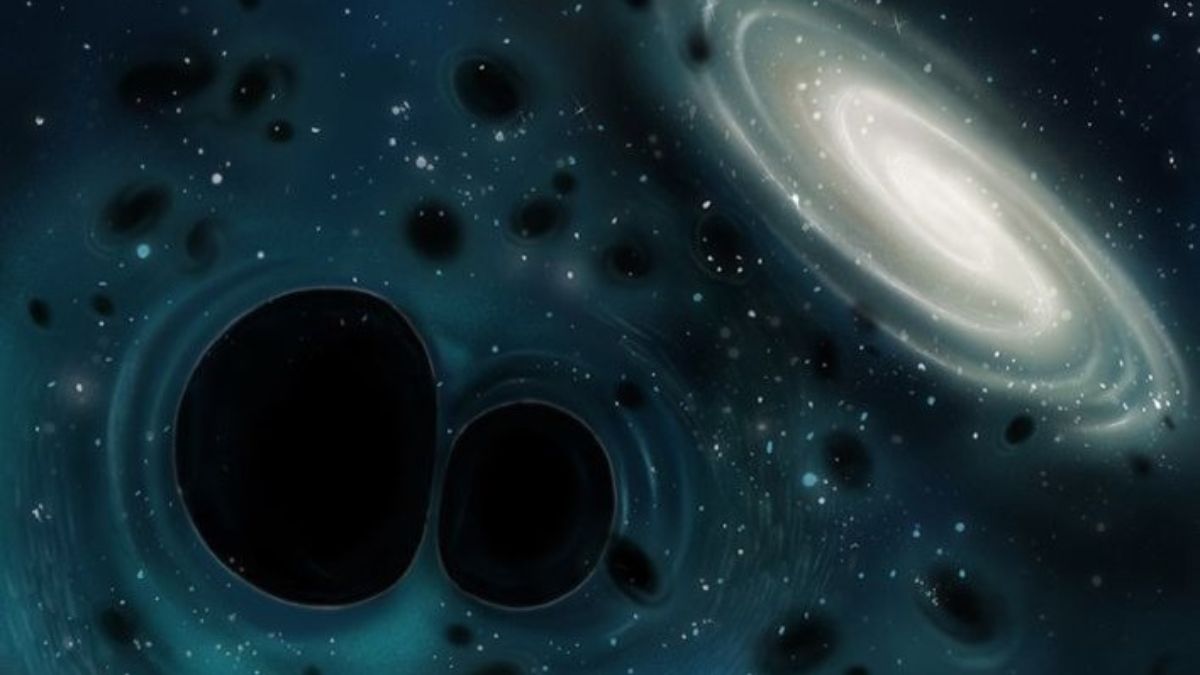
The type of black hole that might explode isn’t one of the gigantic monsters sitting at the center of galaxies. It’s something much smaller and far older—primordial black holes. These tiny black holes are believed to have formed right after the Big Bang, in the earliest moments of the universe’s existence.
Unlike the black holes we usually hear about—ones formed by the death of massive stars—primordial black holes could be as small as an asteroid. And because they’re tiny, they’ve been quietly losing mass over billions of years and could now be nearing the end of their lives.
Evaporation
In 1974, Stephen Hawking proposed something revolutionary: black holes aren’t completely black. They slowly release particles over time through a process now called Hawking radiation. This means they lose mass, and if they’re small enough, they eventually vanish in a burst of energy.

For massive black holes, this process takes longer than the current age of the universe. But primordial black holes are a different story. Some of them could be reaching their final moments right now, and when they do, the result could be a massive explosion—possibly brighter and more energetic than a supernova.
Discovery
So, what exactly would astronomers see if one of these ancient black holes exploded? A whole lot of new particles.
Here’s what could be released:
- Known particles like electrons, protons, and neutrons
- Hypothetical ones like dark matter particles
- Completely unknown particles that might reveal new laws of physics
Imagine it as opening a cosmic treasure chest full of secrets we’ve never seen before. Joaquim Iguaz Juan, an astrophysicist involved in the study, said this kind of explosion “would completely revolutionize physics and help us rewrite the history of the Universe.”
Surprise
Until recently, astronomers thought these kinds of black hole explosions were almost impossible to witness—maybe once every 100,000 years. But the new research flips that assumption. The scientists now believe we could see one about once every ten years.
So why haven’t we seen one already?
It turns out some of these tiny black holes might be lingering longer than expected, thanks to a strange concept: the dark electron. This is like a regular electron but much heavier, and it could give primordial black holes a hidden electric charge that delays their final explosion.
Physicist Michael Baker suggests that this might allow these black holes to “temporarily stabilize before they explode,” giving us a better shot at catching one in action.
Detection
If this event happens nearby in the sky, astronomers believe we already have the tools to see it. Gamma ray observatories currently watching the skies should be able to detect the signal of a black hole’s final burst.
And if they do, we’re not just confirming one theory—we’re checking off several cosmic mysteries all at once:
- Proof that primordial black holes exist
- The first real evidence of Hawking radiation
- A glimpse at particles we’ve never detected before
It’s the kind of event that could bridge the gap between quantum mechanics and general relativity—two of the most important, yet stubbornly incompatible, areas of physics.
Potential
In the next decade, we might witness something that’s never been seen before: a black hole’s death. But this death won’t be the end. It could be the beginning of a new era in science, one where we finally unlock the hidden layers of the universe.
Will it prove the existence of dark matter? Possibly. Will it uncover new forces or particles? Likely. Will it blow our minds? Absolutely.
One thing is certain—astronomers are watching the skies closer than ever, and the countdown has already begun.
FAQs
What is a primordial black hole?
It’s a tiny black hole from the early universe, unlike massive ones.
What causes a black hole to explode?
Hawking radiation makes small black holes evaporate and explode.
What will we see in the explosion?
A burst of particles—known, unknown, and maybe dark matter.
Why haven’t we seen one before?
They may have been delayed by ‘dark electrons’ stabilizing them.
Can we detect the explosion today?
Yes, gamma ray observatories can spot it if it’s nearby.