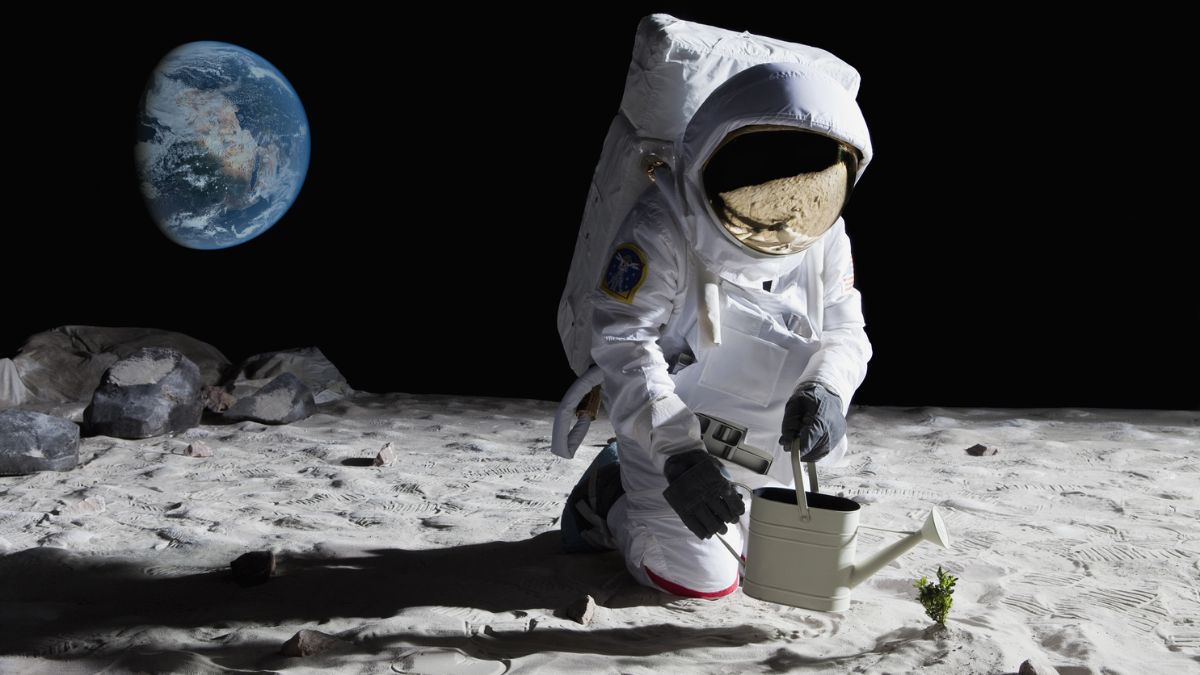
What if one day, astronauts on the Moon could relax with a hot cup of tea? Sounds like something out of science fiction, right? Well, a team of British scientists just proved that this might not be such a far-fetched idea after all. Researchers from the University of Kent have successfully grown tea plants in soil that mimics the Moon’s surface. And yes—it worked!
Let’s look into how this surprising experiment came to life and why it’s such a big deal for space and Earth alike.
Table of Contents
Experiment

This innovative project was led by Professor Nigel Mason from Kent’s School of Physics and Astronomy and Dr. Sara Lopez-Gomollon from the School of Biosciences. Together with students Anna-Maria Wirth and Florence Grant, they asked a wild but fascinating question: Can tea grow in lunar soil conditions?
To find out, they planted young tea saplings in different types of simulated soil:
- Lunar soil simulation
- Martian soil simulation
- Earth soil (used as a control)
Their goal? To see if tea plants could grow in the harsh environments astronauts might face in future space colonies.
Results
The saplings were monitored for weeks under carefully controlled conditions, including temperature, humidity, and lighting—just like they might experience on the Moon or Mars.
Here’s what they discovered:
| Soil Type | Growth Result |
|---|---|
| Lunar Simulation | Plants flourished |
| Earth Soil | Normal healthy growth |
| Martian Simulation | Plants failed to grow |
The most unexpected result? The tea plants in the lunar-like soil not only survived—they flourished. Meanwhile, those in the Martian soil didn’t grow at all.
Importance
So, why does growing tea on fake Moon dirt matter?
This experiment is part of a broader field called space agriculture—the study of how to grow food in space. If humans are going to live on the Moon or Mars for extended periods, they’ll need to grow their own food. Being able to cultivate something as complex as tea proves we’re one step closer to that future.
Dr. Lopez-Gomollon noted that the results were encouraging because tea is a crop—not just a weed or a test plant. She explained that this shows we can consider real food sources for future space missions, not just basic survival plants.
And let’s not forget the cultural angle. As Professor Mason pointed out, “it is reassuring that we may be able to provide access to the great British tradition of a tea break,” even in space.
Impact
This experiment also brings lessons for farming back here on Earth.
Studying how tea plants adapt to nutrient-poor, simulated lunar soil offers clues about how crops might survive in degraded or climate-stressed environments on our own planet. With global soil quality dropping due to over-farming and climate change, these findings could help create more resilient agricultural systems in the future.
In short, learning how to grow tea on the Moon might help us grow food in dry, poor-quality soils right here on Earth.
Teamwork
This wasn’t just a university lab experiment. Several partners played key roles in the project:
- Dartmoor Tea: A British tea plantation that offered crop expertise
- Lightcurve Films: A space documentary group that helped document the process
- Europlanet: A European network of planetary scientists
This collaboration shows how science, culture, and international teamwork can come together for groundbreaking innovations. A simple idea—can tea grow on the Moon?—led to insights that could benefit both future space missions and Earth-based agriculture.
Fascination
It’s pretty mind-blowing, right? We often think of space as unreachable or untouchable, but more and more, science is bringing it closer to home. What started as an unusual experiment now holds real potential for life beyond Earth—and for solving agricultural problems right here.
Next time you sip a cup of tea, just imagine doing it under the stars… on the Moon.
FAQs
Did tea really grow in lunar soil?
Yes, tea plants grew successfully in simulated lunar soil.
Why didn’t tea grow in Martian soil?
Martian soil conditions were too harsh for growth.
What is space agriculture?
It’s the science of growing food in space environments.
Who led the tea experiment?
Prof. Nigel Mason and Dr. Lopez-Gomollon from Kent University.
Can this help farming on Earth?
Yes, it offers insights for growing crops in poor soils.