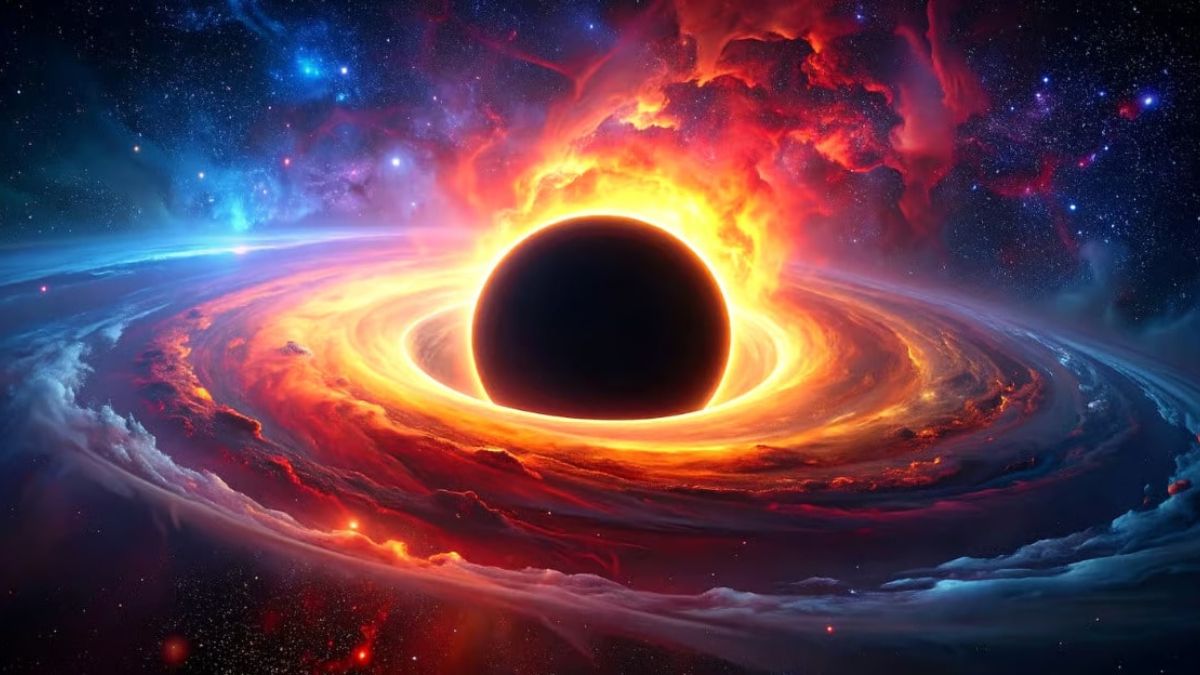
There’s talk of an unexpected cosmic event that sounds straight out of a sci-fi blockbuster—but this one is grounded in real science. Physicists are warning that a tiny black hole might be on the verge of exploding somewhere near Earth, and it could happen before 2035.
It wouldn’t be dangerous to us, but it could change everything we know about the universe. This explosion might finally prove one of Stephen Hawking’s most famous theories—about how black holes don’t last forever.

Let’s cut into what’s actually going on, what these strange black holes are, and how close we might be to witnessing a cosmic firework show that could rewrite the laws of physics.
Table of Contents
Primordial
Most of us think of black holes as giant, star-eating monsters. They form when huge stars collapse under their own weight. But there’s another type of black hole that’s way smaller and far older—primordial black holes. These weren’t born from dying stars. They came into existence just moments after the Big Bang, when the universe was still incredibly hot, dense, and chaotic.
Picture this: the universe was a fraction of a second old. Matter was packed tightly together. In all that cosmic mess, small clumps of matter collapsed into mini black holes. Some were as small as a mountain, others the size of an atom. Over billions of years, many may have vanished. But what if some are still out there, quietly floating through space?
Hawking

Stephen Hawking once proposed that black holes aren’t completely black. They slowly emit energy, a process known as Hawking radiation. This radiation causes black holes to shrink over time. Eventually, if they get small enough, they don’t just vanish—they explode in a sudden release of light and energy.
But here’s the twist: scientists believed these tiny black holes should have exploded long ago. So, they weren’t expecting to actually find any still alive today. That’s where the latest theory shakes things up.
Charge
A new study from physicists at the University of Massachusetts Amherst suggests something surprising: some primordial black holes might carry a “dark charge.” This isn’t like electric charge. It only interacts with dark matter—the mysterious, invisible stuff that makes up most of the universe but doesn’t shine or reflect light.
This dark charge could act like a stabilizer, helping these black holes survive for billions of years. Think of it like a cosmic battery holding a charge for ages. Eventually, that charge could drain, causing the black hole to release all its energy in a single, massive explosion.
That’s the moment scientists are hoping to catch.
Explosion
So, what would this explosion look like? You wouldn’t see it with your eyes. It wouldn’t light up the sky like fireworks. Instead, it would release a sharp burst of gamma rays—one of the highest-energy forms of light in the universe.
To spot it, we’d rely on powerful observatories like HAWC in Mexico or LHAASO in China. These facilities are designed to detect gamma-ray bursts, especially ones coming from close by in cosmic terms (think a few astronomical units).
Catching such an event would be a massive win for science. It would confirm Hawking’s theory of black hole evaporation. And beyond that, it might reveal hidden particles—mysterious building blocks that make up the fabric of the universe.
Impact
Let’s take a moment to grasp how big this would be. We’re talking about a discovery that could shake the foundations of modern physics. If one of these ancient black holes does explode near Earth, it might offer our first real evidence of how quantum mechanics and gravity work together.
It could also prove that dark matter isn’t just a passive part of the universe. It might have its own hidden forces, and black holes could be the key to unlocking them.
All of this comes from a serious set of calculations—combining Einstein’s general relativity, quantum field theory, and particle physics. And according to these equations, there’s more than a 90% chance we’ll witness such an event in the next decade.
Here’s a quick breakdown of what this could mean:
| Factor | Impact |
|---|---|
| Hawking radiation confirmed | Proves black holes can evaporate |
| Dark matter interaction | Suggests new forces in the universe |
| Gamma-ray burst detection | First real signal of a black hole explosion |
| Quantum-gravity connection | Links small-scale physics with large-scale |
Future
So, what’s next? Scientists are keeping their eyes on the sky. They’re tracking any strange bursts of energy and running more simulations to find out where a potential explosion might come from.
Even if it doesn’t happen by 2035, the search itself is already pushing science forward. We’re developing better detectors, running more detailed models, and expanding our understanding of cosmic events.
But if it does happen… the universe might just hand us one of the biggest scientific discoveries in modern history.
Imagine being alive to witness the death of a black hole that’s been drifting silently since the birth of time. One tiny cosmic spark could light up answers to some of the universe’s deepest questions.
FAQs
What is a primordial black hole?
A tiny black hole formed moments after the Big Bang.
Can black holes really explode?
Yes, tiny ones might explode due to Hawking radiation.
What is Hawking radiation?
Energy black holes slowly release over time.
What is dark charge?
A type of charge that interacts only with dark matter.
Are we in danger from this explosion?
No, it’s far away and poses no risk to Earth.