For decades, scientists have tried to trace the tangled roots of our species—where we came from, how we evolved, and which ancient humans we interacted with. The story has always been a complex puzzle, full of bones, migration patterns, and genetics.
But now, researchers have found something that could rewrite the whole human origin story: the hidden DNA of a mysterious human ancestor that vanished over 600,000 years ago.

No bones, no fossils—just a genetic ghost, quietly living inside the DNA of millions of people today.
Table of Contents
Genome
This groundbreaking discovery comes from researchers Arun Durvasula and Sriram Sankararaman at UCLA. They weren’t digging through caves or ancient tombs. Instead, they studied the DNA of modern West African populations—and what they found shocked the scientific world.
Using advanced computational models, they spotted signs of an ancient “ghost lineage.” That’s science-speak for a human species we’ve never seen, but we know existed—because its DNA is still here, passed down from generation to generation.

And here’s the kicker: this mysterious ancestor isn’t related to Neanderthals or Denisovans. It’s something else entirely—a long-lost cousin on a separate branch of the human family tree.
Genetic
Unlike most ancient human discoveries, this one didn’t come from bones or stone tools. It came from genetics.
Scientists examined the DNA of four African ethnic groups, including the Yoruba from Nigeria. When they compared that DNA to other known human ancestors, they found something strange. Between 2% and 19% of the DNA didn’t match any known species.

This wasn’t contamination. It wasn’t an error. It was the signature of an ancient, unknown human who lived more than 600,000 years ago—long before Neanderthals or Denisovans walked the Earth.
Because Africa’s environment is harsh on ancient DNA, it’s nearly impossible to extract usable genetic material from fossils found there. That’s why this type of “genetic archaeology” is so powerful. Instead of looking for ancient bones, scientists are scanning the DNA of living people for ancestral fingerprints.
Traces
So, what’s actually left of this ghost ancestor? Tiny fragments of DNA—some helpful, some useless. But one of the most fascinating pieces is a gene called NF1, which helps protect against tumors.
This gene, passed down from the unknown ancestor, appears unusually often in certain African populations. That suggests natural selection may have preserved it because it offered a survival benefit.
We’ve seen similar things with Neanderthal DNA in non-African populations. Those ancient genes helped modern humans adapt to cold climates and fight off new diseases. It looks like this ghost ancestor played a similar role in helping West Africans survive in a tough and changing environment.
But not all the inherited DNA was useful. Much of it faded out, suggesting that not all interbreeding between species produced healthy, fertile offspring.
Mystery
Here’s the big question: Who was this lost human ancestor?
That’s where things get fuzzy. Without fossils or full DNA samples, scientists are basically working with shadows. They know something was there, but they can’t quite make out what it looked like.
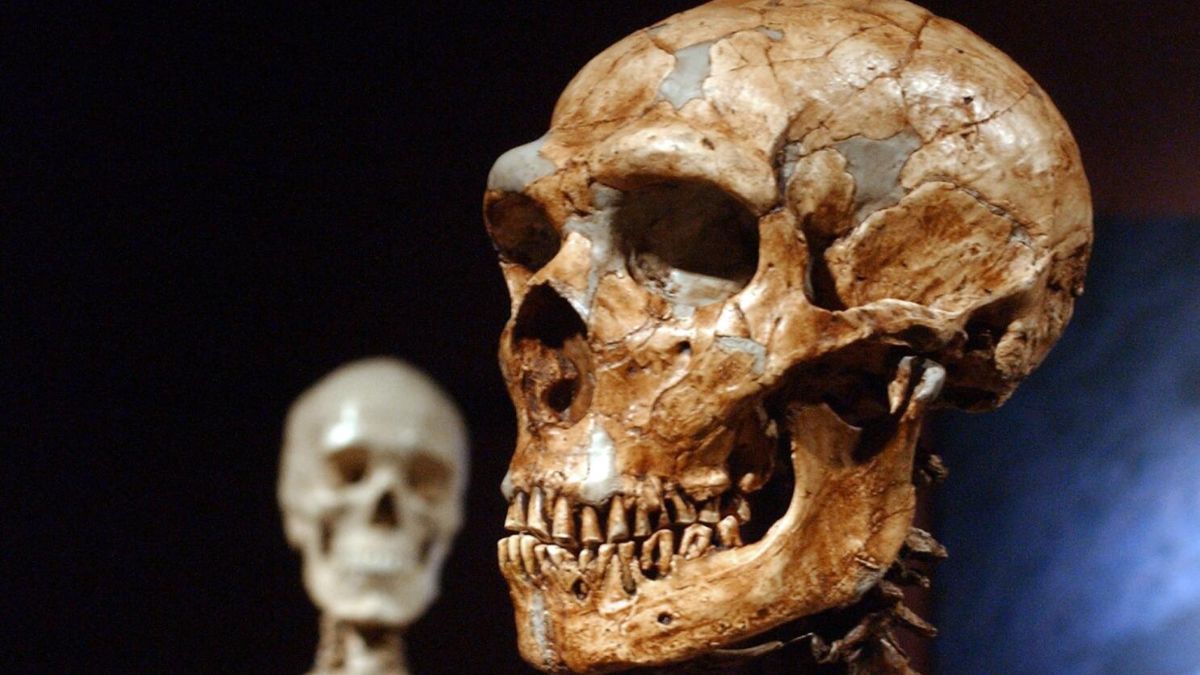
Some experts think it might have been Homo heidelbergensis, a now-extinct species that lived in Africa over 200,000 years ago and may have been the common ancestor of both Neanderthals and modern humans.
Others suggest it could’ve been a group of early Homo sapiens that evolved separately in West Africa, living in isolation and developing distinct traits before merging back into the larger population.
Africa
This entire discovery challenges the old, simple story of human evolution—that all humans came from a single “cradle” in Africa. Instead, it paints a picture of early Africa as a melting pot of different human groups.
They didn’t just evolve in straight lines. They met, mixed, and disappeared—leaving bits of their genetic legacy behind.
The idea now gaining traction among scientists is that humanity evolved in a network of populations spread across Africa. These groups occasionally merged and exchanged DNA, like branches weaving together into a tangled tree, rather than one straight trunk.
Legacy
The most mind-blowing part? Millions of people living today still carry this ancient genetic code from an ancestor we didn’t even know existed until recently.
That means your DNA could be part of the legacy of a species that left no trace—no bones, no tools, no burial sites—just invisible evidence hidden in your genetic code.
And that’s powerful. It reminds us that human history is not a closed book. It’s a living story, one we’re still writing with every scientific discovery.
FAQs
What is a ghost lineage?
A lost human species known only from DNA, not fossils.
How old is the unknown ancestor?
Over 600,000 years old, older than Neanderthals.
Where was this DNA found?
In West African populations, including the Yoruba.
What gene was passed down?
A gene called NF1, which helps prevent tumors.
Do we have fossils of this species?
No, only DNA evidence has been found so far.