A new chapter in energy innovation has begun. The world’s largest and most ambitious energy experiment, ITER, has officially started assembling its core. This marks a historic moment in the quest to unlock the power of fusion — the same energy that fuels the Sun and stars.
Designed to create clean, safe, and practically unlimited energy, ITER isn’t just a scientific project. It’s a global collaboration on a scale never seen before.

Let’s take a closer look at how this mega-project is reshaping the future of power.
Table of Contents
Launch
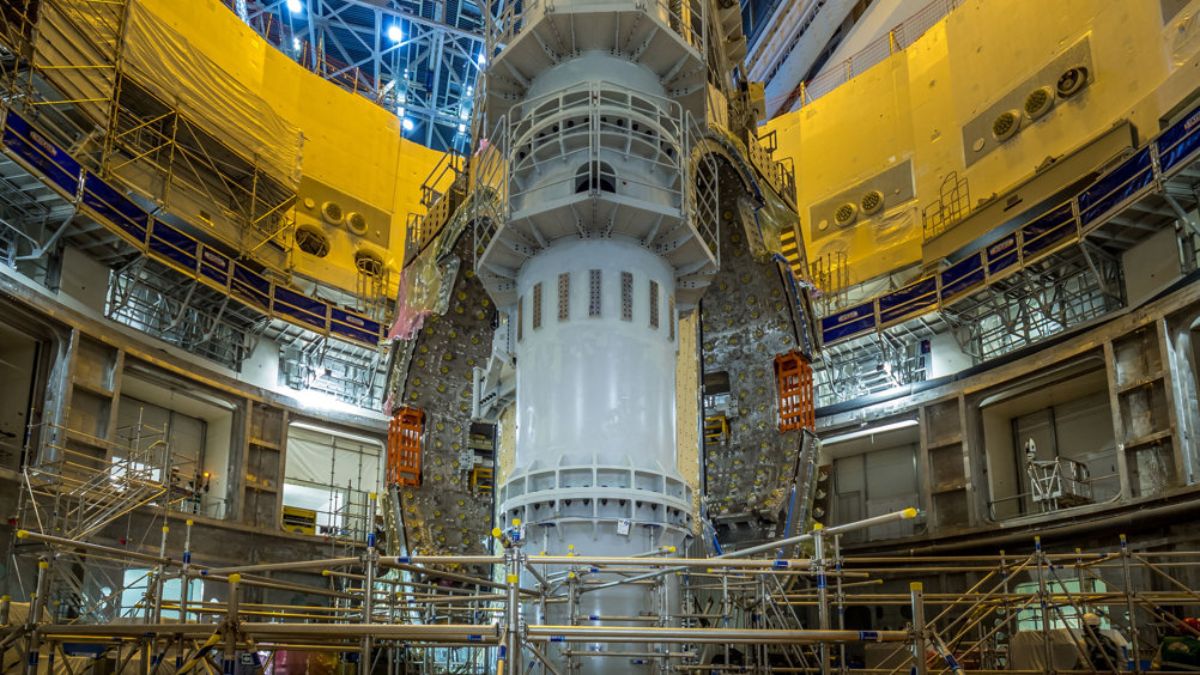
In August 2025, ITER entered its most critical phase: the final assembly of its tokamak, the machine that will host fusion reactions. This stage is led by Westinghouse Electric Company, a U.S.-based nuclear power pioneer. They’re tasked with assembling the massive vacuum vessel — a donut-shaped chamber made of 400-ton steel sections that must fit together with extreme precision.
Once completed, this chamber will hold plasma, a superheated gas that reaches over 150 million degrees Celsius. At that temperature, hydrogen atoms collide and fuse, releasing immense energy. That’s fusion. And if all goes well, ITER will become the first machine to demonstrate more energy output than input from this reaction.
Partners

ITER isn’t just a scientific feat — it’s a masterpiece of global cooperation. A total of 35 nations are involved, representing over half the world’s population and most of its economic power. Each country contributes specialized parts and technologies. These pieces are built across the globe and shipped to the construction site in southern France.
Here’s a breakdown of who’s doing what:
| Country/Region | Main Contribution |
|---|---|
| European Union | Site construction, buildings, and nearly half of components |
| United States | Central solenoid magnet, cooling systems |
| China | Correction coils, power-supply equipment |
| Japan | Toroidal field coils, solenoid conductor |
| Russia | Magnetic coils, diagnostic systems |
| India, South Korea | Additional reactor parts and systems |
This isn’t just teamwork — it’s a global jigsaw puzzle built with atomic-level accuracy.
Assembly

Westinghouse’s role in ITER is anything but simple. Working alongside Italian firms Ansaldo Nucleare and Walter Tosto, they’ve spent over a decade fabricating and assembling reactor sectors. Together, they’ve completed five of the nine major sectors that make up the vacuum vessel.
This structure must be absolutely airtight and heat-resistant to handle plasma hotter than the Sun’s core. Each segment needs to fit perfectly, like slices of a colossal steel pie, joined with millimeter precision. It’s like building a spacecraft — but one that sits on Earth and imitates a star.
Purpose
So, what’s the goal here? ITER aims to be the first fusion reactor to produce more energy than it consumes. Specifically, it’s designed to output 500 megawatts of fusion power using just 50 megawatts of input power. That’s a 10x energy gain — a game-changer if proven successful.
Fusion has always been the “holy grail” of clean energy. Unlike traditional nuclear power, which splits atoms and creates radioactive waste, fusion merges atoms and leaves almost nothing harmful behind. It’s safe, clean, and the fuel — isotopes of hydrogen — is found in seawater.
Delays
As with any massive scientific project, ITER hasn’t had a smooth ride. Construction started back in 2010, and the original target was to generate its first plasma by 2018. That didn’t happen. Complex coordination between nations, engineering hurdles, and precision manufacturing caused delays.
The current projection is that ITER will begin deuterium-tritium testing by 2035. While that sounds far off, consider what’s at stake: solving the world’s energy crisis permanently. For a project of this scale and importance, patience might be a worthwhile price to pay.
Future
It’s important to note that ITER won’t be connected to power grids. Instead, it’s a testbed — a proof of concept for future commercial reactors, like the planned DEMO reactor. DEMO will take what ITER learns and scale it to generate electricity for cities and industries.
Fusion’s potential benefits are enormous:
- No greenhouse gases.
- No nuclear meltdown risks.
- No long-lived radioactive waste.
- An almost endless fuel source from water.
If ITER succeeds, it will pave the way for a world powered by star energy — safely, sustainably, and with minimal environmental impact.
So yes, ITER is a machine. But it’s also a symbol — of cooperation, of innovation, and of hope for a future where energy is abundant and clean.
FAQs
What is the purpose of ITER?
To prove fusion energy can produce more power than it uses.
Where is ITER being built?
In Cadarache, southern France.
Who leads the core assembly of ITER?
Westinghouse Electric Company.
How hot does the ITER plasma get?
Over 150 million degrees Celsius.
When will ITER begin full testing?
Around the year 2035.