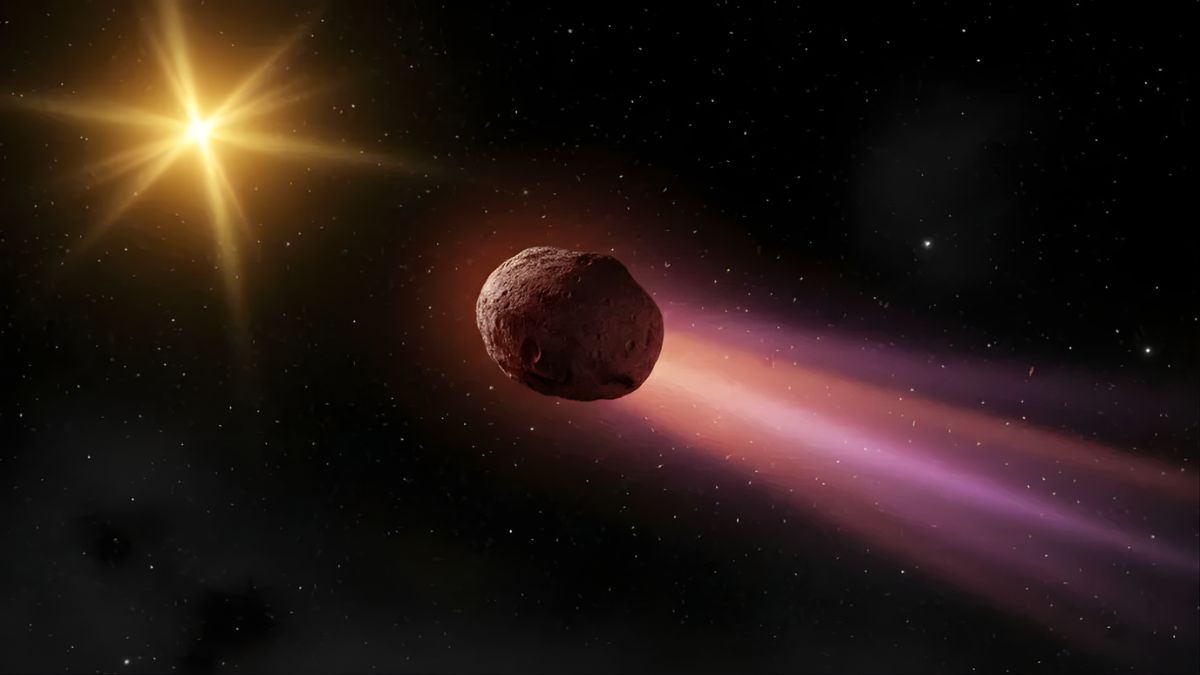
3I/ATLAS might look like just another passing comet, but this isn’t your average space rock. It’s a true cosmic traveler—a frozen relic from beyond our Solar System, shaped by the harsh vacuum of interstellar space.
Thanks to NASA’s James Webb Space Telescope (JWST), scientists have now uncovered exotic compounds on its surface that are rewriting what we thought we knew about these visitors from other star systems.
Table of Contents
Fossil

Let’s start with what 3I/ATLAS really is. This object has been drifting through deep space for more than 7 billion years—making it older than our Sun. Most of that time, it’s been completely exposed to cosmic radiation, which has slowly but relentlessly altered its surface. The result? A hardened, layered shell of dust and ice, transformed into something like a space fossil.
Back in its original system, it probably looked like a typical comet. But now, after millennia of galactic exposure, it’s been chemically reworked from the outside in. JWST observations reveal that this crust is dominated by carbon dioxide, a compound formed and hardened by exposure to galactic cosmic rays.
Scientists believe this damage reaches at least 20 meters deep into the comet. Underneath? Possibly untouched material from a completely different era of the universe.
Traveler
3I/ATLAS was first detected in July, hurtling through our Solar System at more than 210,000 km/h. That’s fast enough to cross Earth in seconds. On October 29, it made its closest pass to the Sun, and that’s when things really got interesting.
The Sun’s heat caused the comet’s surface to sublimate—a process where ice turns straight into gas. But here’s the twist: only the burned outer layer released gases. The JWST picked up signatures of exotic compounds that don’t match what we expect from comets that formed within our Solar System.
That means we’re not seeing the material from its original home—we’re seeing what 7 billion years of radiation created.
Chemistry
This discovery is huge because, until now, astronomers believed that interstellar objects like 3I/ATLAS preserved the chemical fingerprint of their home systems. They were supposed to be time capsules of ancient stars and planets.
Not anymore.
The James Webb data confirms that long-term cosmic exposure rewrites the chemistry of these objects. Over time, cosmic rays penetrate the surface and change the compounds entirely, leaving behind a processed shell that’s chemically alien to its original form.
So instead of being perfect messengers from other systems, interstellar objects might be more like well-traveled tourists, showing more of where they’ve been than where they came from.
Oldest
3I/ATLAS isn’t just exotic—it’s ancient. Scientists believe it’s at least 3 billion years older than the Solar System itself. That makes it one of the oldest objects ever observed.
To better understand it, researchers compared it with comet 67P/Churyumov-Gerasimenko, which was studied by the Rosetta mission. Even just one billion years of exposure to galactic radiation creates a hardened crust. Now imagine what happens after seven billion years.
The comparison gives us a better timeline for how space transforms matter, and why interstellar objects like 3I/ATLAS arrive so different from what we expect.
Reveal
Some scientists are hopeful that the Sun’s heat might erode the surface enough to peel back that hardened layer. If that happens, we could get a glimpse at the original core—a piece of material that has remained unchanged since before our Sun was even born.
Imagine that: a look into the raw ingredients of a star system long lost to time.
The research, titled “Interstellar Comet 3I/ATLAS: Evidence for Galactic Cosmic Ray Processing”, is currently under peer review. But already, the Webb’s findings have changed how we see interstellar objects.
Message
3I/ATLAS is more than just a comet. It’s a messenger from the past, carrying the marks of cosmic history written across its surface. It proves that even something as cold and distant as a comet is still alive with stories—stories about stars, space, time, and change.
And perhaps, if we’re lucky, stories about the birthplaces of life itself.
FAQs
What is 3I/ATLAS made of?
Its surface contains carbon dioxide hardened by radiation.
How old is 3I/ATLAS?
It’s over 7 billion years old—older than our Solar System.
What did James Webb detect?
Exotic compounds altered by galactic cosmic rays.
Can we see its original core?
Possibly, if solar heat erodes the outer layer.
Why is this discovery important?
It changes how we understand interstellar object chemistry.