Mars—the rusty-red planet hanging in our night sky—is more than just a backdrop for science fiction. It’s a real place, our planetary neighbor, and one of the most studied worlds in the solar system.
Even though humans haven’t landed there yet, our robots, probes, and orbiters have gathered a mountain of data that keeps scientists hooked. Why? Because Mars could hold the answers to one of our biggest questions: Was there ever life beyond Earth?

Let’s cut into the fascinating world of the Red Planet and see what makes it so unique.
Table of Contents
Origins
Mars has been known since ancient times. The Greeks associated its reddish glow with Ares, the god of war. The Romans later named it Mars—same god, different name. That red tint comes from iron oxide (basically rust) coating its surface. It’s not just for show; this coloring also hints at Mars’ geological history.
Even though it’s called the Red Planet, a closer look reveals shades of beige, gold, tan, and brown—like an artist’s dusty palette.
Structure

Mars is the fourth planet from the Sun and is classified as a rocky planet, just like Earth. It’s about half Earth’s size and much lighter, making its gravity only about 38% of ours. So if you weighed 100 kg on Earth, you’d only weigh 38 kg on Mars!
Inside, Mars has a layered structure:
- Core: Mostly iron, nickel, and sulfur
- Mantle: Made of silicate rock
- Crust: Rich in elements like magnesium, aluminum, potassium, and iron
It’s also geologically active. Marsquakes—similar to earthquakes—occur regularly, showing that the planet isn’t dead inside.
Surface
Mars is full of extremes. Its geography includes some of the most jaw-dropping features in the solar system:
| Feature | Description |
|---|---|
| Olympus Mons | Largest volcano in the solar system (22.5 km tall) |
| Valles Marineris | Canyon system 4,800 km long and 7 km deep |
| Polar Ice Caps | Made of frozen water and CO₂ |
| Cratered Terrain | Result of meteorite impacts over billions of years |
Though it’s dry today, scientists believe Mars once had rivers, lakes, and maybe even oceans. Most of the water now is frozen as ice below the surface or at the poles.
Climate
Despite its warm colors, Mars is a cold place. Daytime temperatures might reach 20°C in the warmest spots, but nights can plunge to -153°C. That’s colder than Antarctica on its worst day.
Its atmosphere is very thin—about 1% of Earth’s—and made mostly of carbon dioxide. It also contains small amounts of nitrogen and argon. Because of this, Mars:
- Doesn’t trap heat well
- Can’t support liquid water for long
- Has no protection from solar radiation
- Gets bombarded by meteorites
One of Mars’ biggest challenges is its massive dust storms. These can cover entire regions—or the whole planet—and last for weeks. Imagine a sandstorm that spans an entire continent!
Seasons
Just like Earth, Mars has seasons because of its tilted axis. But they last longer—one Martian year equals about 687 Earth days. So, if you lived on Mars, your birthday would only come around every two Earth years!
Moons
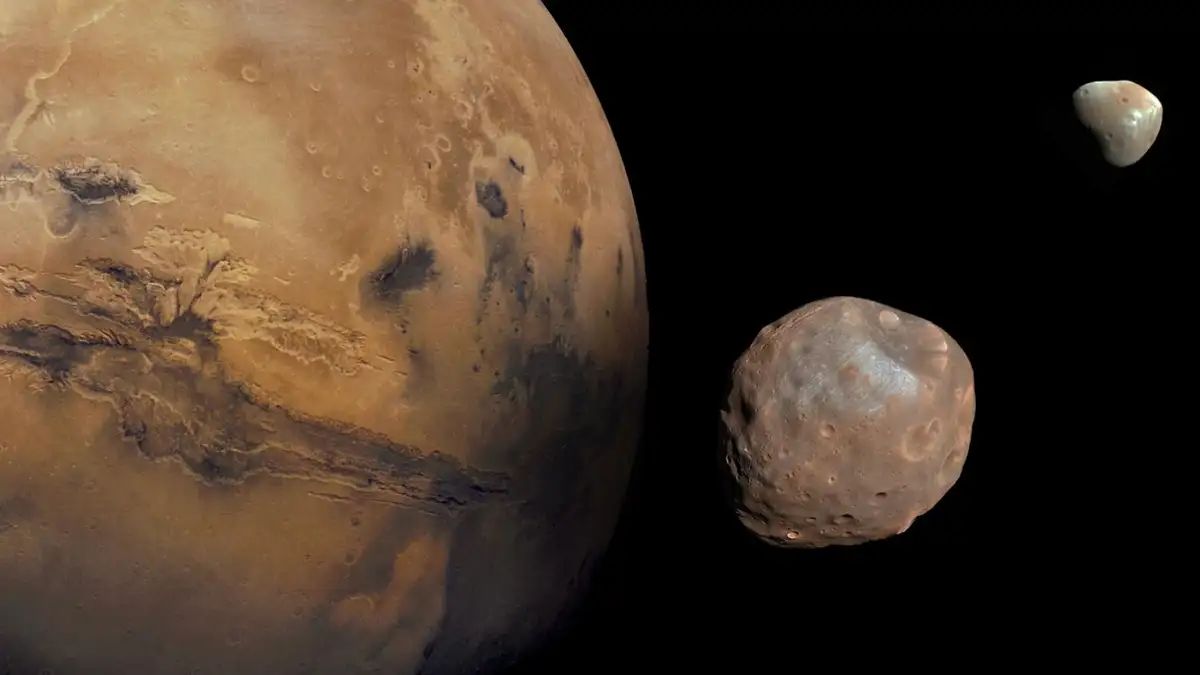
Mars has two small moons, Phobos and Deimos. Unlike our Moon, they’re irregularly shaped and much smaller. Scientists believe they were once asteroids that got caught in Mars’ gravity. They orbit the planet quickly, especially Phobos, which completes a full loop in just 7.5 hours!
Exploration
We’ve never walked on Mars, but we’ve definitely rolled across it. Here’s a quick rundown of some key missions:
| Mission | Year | Achievement |
|---|---|---|
| Mariner 4 | 1964 | First successful flyby and images of Mars |
| Viking I & II | 1970s | First landers to study the Martian surface |
| Spirit & Opportunity | 2003 | Rovers that discovered signs of water |
| Curiosity | 2011 | Studying geology and past habitability |
| Perseverance | 2020 | Searching for ancient life, collecting samples |
| Ingenuity | 2020 | First powered flight on another planet |
These missions have told us a lot—but they’ve also raised more questions. The ultimate goal? A human mission to Mars, possibly between 2035 and 2045. That’s not too far off!
Until then, NASA and other space agencies continue their robotic missions, preparing the way for human explorers.
FAQs
Why is Mars called the Red Planet?
Because its surface is covered in iron oxide, which looks red.
Does Mars have water?
Yes, mostly as ice below the surface and at the poles.
What is Olympus Mons?
The tallest volcano and mountain in the solar system.
Can humans survive on Mars now?
No, due to thin air, radiation, and extreme cold.
When will humans go to Mars?
NASA aims for a manned mission between 2035 and 2045.