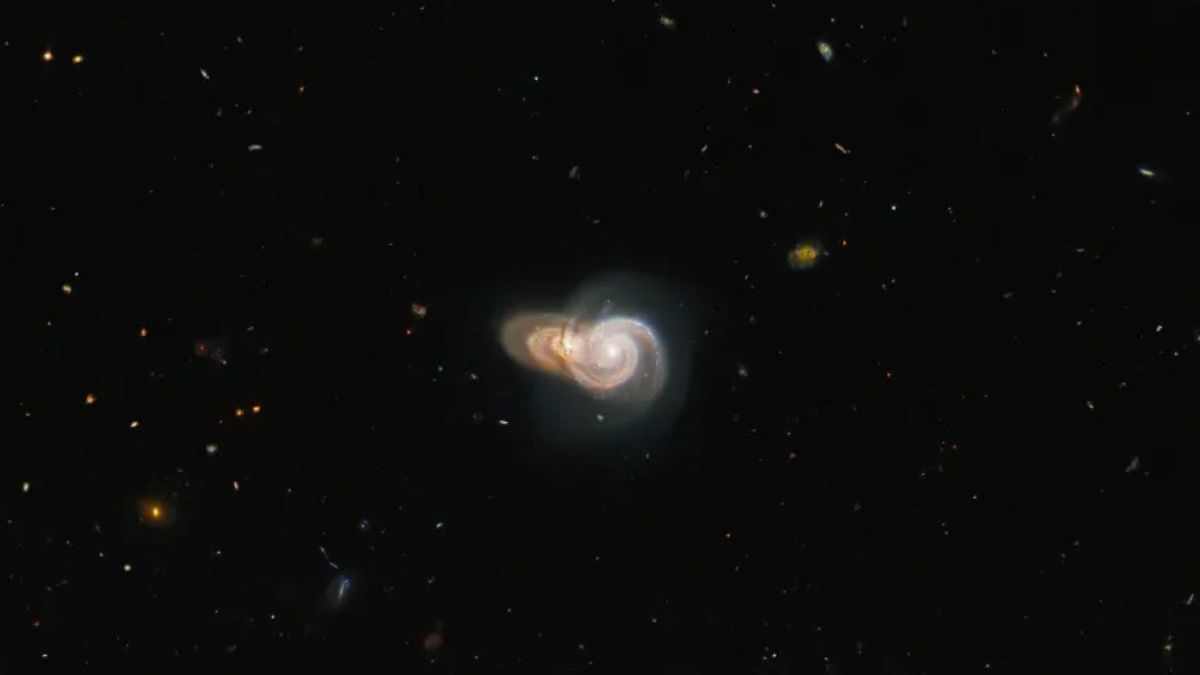
A discovery from the southern skies is rewriting what astronomers know about galactic scale. Using the powerful MeerKAT radio telescope, scientists have found Inkathazo, a giant radio galaxy (GRG) that stretches across an astonishing 3.3 million light-years—making it more than 32 times the size of our Milky Way.
The name Inkathazo, meaning “trouble” in isiXhosa and isiZulu, reflects the mystery it brings to the table. This enormous structure is not only massive but unusually shaped and located in a region that challenges existing theories about how such galaxies grow.

Let’s look into what makes Inkathazo so exceptional and why this discovery matters.
Table of Contents
Inkathazo
Inkathazo is classified as a giant radio galaxy, or GRG. These are galaxies with enormous plasma jets, which are emitted from the supermassive black holes at their centers. These jets radiate in the radio frequency spectrum, which is how MeerKAT was able to detect them.
What makes Inkathazo so strange is that:
- It spans 3.3 million light-years across.
- One of its jets is rounded, which is uncommon.
- It sits in a compact cluster environment, not in an open one like most GRGs.

This all suggests something rare is happening here—and it might not fit into current cosmic models.
Why Is This Galaxy So Big?
The Milky Way, for comparison, is about 100,000 light-years across. Inkathazo dwarfs it by a factor of 32. Only a small number of known GRGs even approach this scale.
There are a few theories about how it could have grown so large:
- Low gas resistance in the region may allow its plasma jets to extend farther.
- Its central black hole could be spinning faster than usual, powering stronger jets.
- Re-energization events might have kept its plasma lobes active longer than expected.

But all these ideas are still being tested, and some researchers believe we might need to rethink our knowing of galaxy evolution altogether.
How Did MeerKAT Spot It?
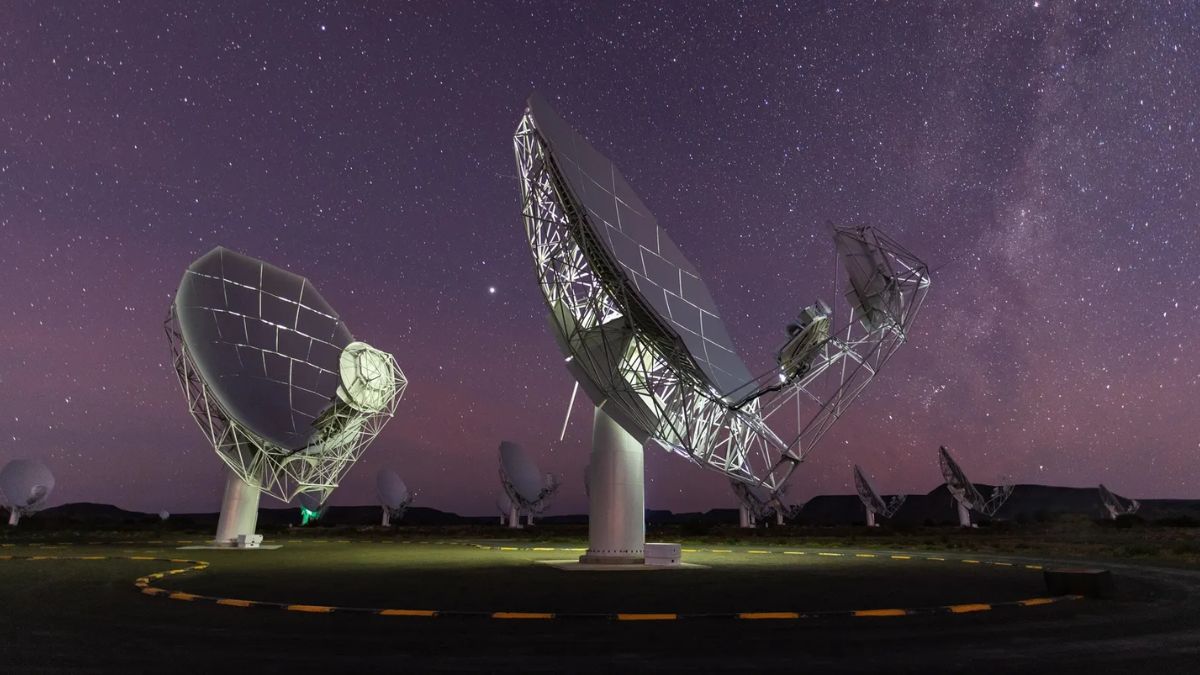
MeerKAT is one of the most sensitive radio telescopes in the world, based in South Africa. It detects radio waves that are invisible to optical telescopes.
While optical telescopes see stars and galaxies as points of light, radio telescopes like MeerKAT can map vast jets of plasma—some stretching across millions of light-years. It’s this capacity that made Inkathazo visible.
MeerKAT has already multiplied the known number of GRGs, and with future surveys, it could find even larger or more unusual structures.
Challenges the Standard Model
The ΛCDM model (Lambda Cold Dark Matter) is the standard theory used to explain the formation of cosmic structures. According to it, large-scale features like GRGs should evolve slowly over billions of years. But Inkathazo appears:
- Larger than expected
- Located in a denser-than-usual environment
- And younger in parts, suggesting recent or ongoing activity
This contradicts the idea that plasma jets should fade over time unless something is re-energizing them or pushing them to grow faster.
Why This Discovery Matters
Inkathazo isn’t just a big galaxy—it’s a giant red flag for existing theories. If such structures are more common than we thought, or if they grow under different conditions, we may need to adjust our knowing of how galaxies form and evolve.
It also proves how vital radio astronomy is. Without instruments like MeerKAT, these colossal systems would remain hidden from view. As we develop even more powerful tools—like the upcoming SKA (Square Kilometre Array)—we may find galaxies that make even Inkathazo look small.
FAQs
What is Inkathazo?
Inkathazo is a newly discovered giant radio galaxy (GRG) that spans 3.3 million light-years, discovered by the MeerKAT telescope.
How does Inkathazo compare to the Milky Way?
It is over 32 times larger in diameter than the Milky Way, which is about 100,000 light-years across.
What makes Inkathazo unique?
Its massive size, asymmetric jet shape, and location in a dense cluster environment challenge existing galaxy formation models.
What is MeerKAT?
MeerKAT is a powerful radio telescope in South Africa, designed to detect radio waves and plasma jets invisible to optical telescopes.
Why is this discovery important?
It suggests that our current knowing of how galaxies grow may be incomplete and highlights the need for better radio-based observations.