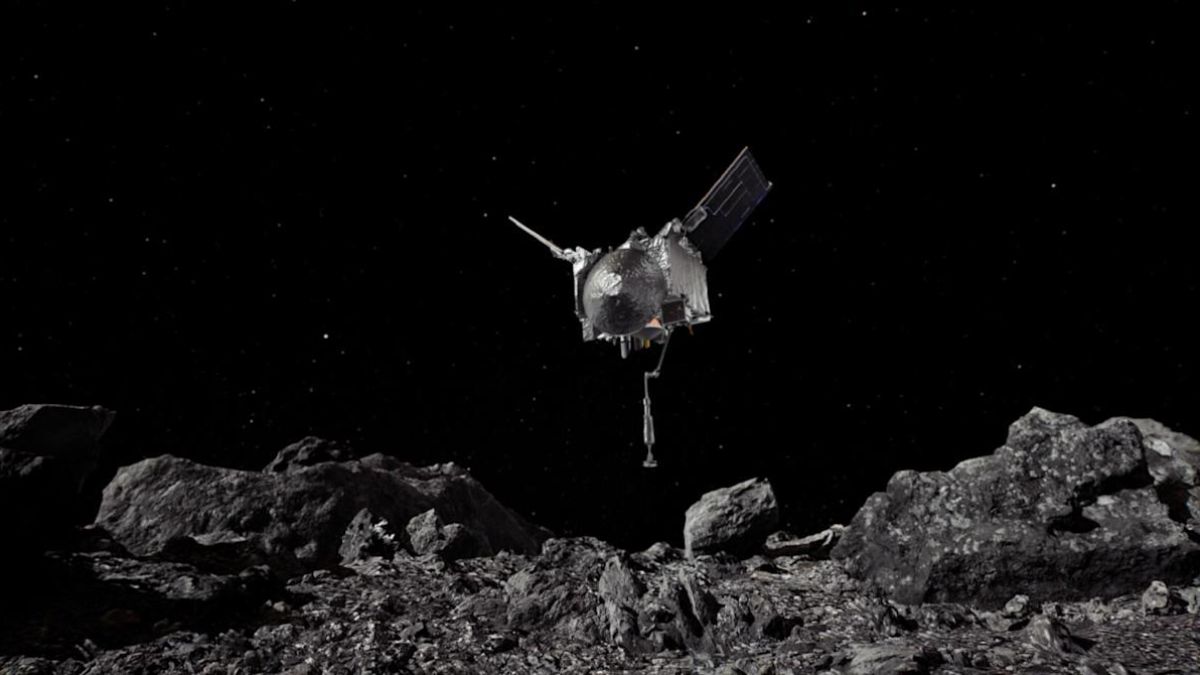
The discovery is official — NASA has found tryptophan in dust samples from asteroid Bennu, and it’s rocking the scientific world. This marks the first time ever that this essential amino acid has been found in extraterrestrial material. For scientists, it’s a breakthrough in astrobiology. For the rest of us? It’s a powerful clue that life’s building blocks may not be exclusive to Earth.
Let’s cut into why this is such a big deal.
Table of Contents
Bennu

Bennu might just look like a dark space rock drifting near Earth, but thanks to NASA’s OSIRIS-REx mission, we now know it holds much more. When the sample capsule landed in the Utah desert, it contained fine dust and tiny rocks collected from Bennu’s surface — and what’s inside those grains is changing what we thought we knew.
The analysis, published in the journal PNAS, used cutting-edge methods to break down Bennu’s material and identify individual molecules. What they found? A chemical jackpot:
- 14 amino acids, including tryptophan
- 5 nucleobases (basic components of RNA and DNA)
- Chemical markers pointing to liquid water
And yes, tryptophan — that’s the same molecule your body uses to build proteins and create serotonin, the “feel-good” hormone.
Tryptophan
So why is everyone so excited about tryptophan?
Because it’s not just any molecule — it’s one of the essential amino acids all life forms on Earth need. Your body can’t make it on its own; you get it from food. It’s responsible for:
- Building proteins
- Regulating mood, sleep, and appetite
- Supporting the immune system
Finding it on an asteroid, where there are no plants, oceans, or biology as we know it, tells us something extraordinary: the ingredients for life can form outside Earth.

And if complex amino acids like this can exist in space, what else might be out there?
Origins
This finding gives new life (pun intended) to an old theory — that life didn’t start from scratch on Earth, but rather was seeded here by asteroids carrying water and organic molecules.
This isn’t science fiction anymore. It’s chemical evidence.
In fact, Bennu shows signs of having liquid water in the past — at least in tiny amounts — and its dust contains zones rich in organic material. That combination of water + molecules + time is exactly the formula needed for complex chemistry… and possibly pre-biotic activity.
Symmetry
Here’s another cool detail from the study: the amino acids in Bennu came in equal parts left- and right-handed versions. On Earth, life uses only the left-handed type. That means Earth’s biological preference developed here, not elsewhere.
So Bennu gives us a “before” snapshot — what things might have looked like before life began selecting one side over the other. It’s a molecular time capsule.
Theory
The idea that life (or its ingredients) may have arrived on Earth via asteroids has often been brushed off as a “fringe theory.” But discoveries like this are giving it serious scientific weight.
During Earth’s chaotic early days, known as the “late heavy bombardment”, our planet was constantly hit by space rocks. If some of those carried amino acids, nucleobases, and even water — Earth could’ve been the perfect incubator to spark life.
It doesn’t mean Bennu had life, but it does mean the potential was there. And that opens a whole new set of questions.
Future
What’s next?
NASA and international scientists will continue studying the Bennu samples to:
- Confirm the presence of tryptophan using other lab techniques
- Map its distribution within the asteroid material
- Estimate how much organic material Bennu contains
While we’re far from solving the ultimate mystery of how life started, we now have a real, physical clue that pushes the boundaries of our understanding.
This isn’t about sci-fi. It’s about chemistry, evidence, and the possibility that life’s ingredients are more universal than we thought.
And isn’t that an exciting idea?
FAQs
What did NASA find on Bennu?
Tryptophan, amino acids, nucleobases, and signs of water.
Why is tryptophan important?
It’s essential for life—used in proteins and serotonin production.
Does this mean Bennu had life?
No, but it had the ingredients needed for life to start.
What is OSIRIS-REx?
A NASA mission that collected and returned samples from asteroid Bennu.
Can life’s building blocks form in space?
Yes, Bennu shows complex molecules can form outside Earth.