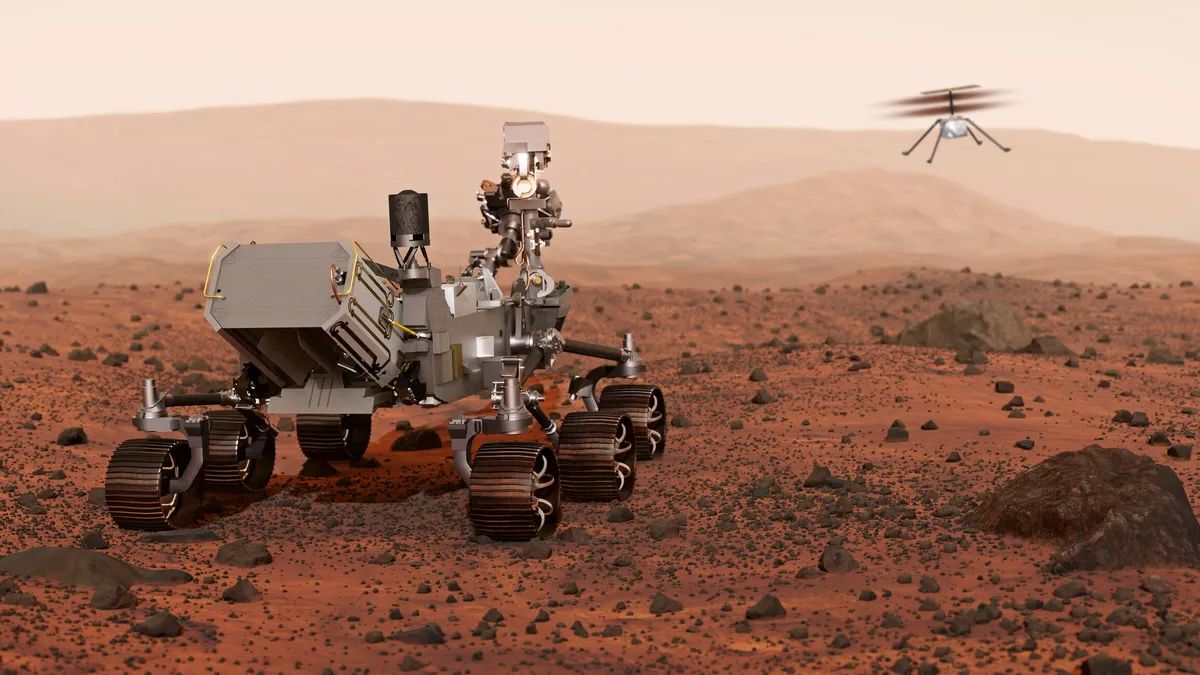
Could life really have existed on Mars? A recent announcement by NASA has everyone talking. The space agency’s Perseverance rover may have uncovered the strongest signs yet that life may once have existed on the Red Planet.
While the discovery isn’t definitive, it’s stirring up serious excitement in the scientific community. So, what exactly did NASA find, and what does it mean for the age-old question: Are we alone in the universe?
Table of Contents
Perseverance

Let’s start with the rover behind the buzz—Perseverance. Since it landed on Mars in 2021, it’s been exploring Jezero Crater, a region believed to have hosted a massive lake and river system billions of years ago. That makes it a prime spot to look for past life.
In 2024, Perseverance studied a unique rock formation named Cheyava Falls. What scientists found inside it blew them away:
- Organic molecules, which on Earth are often linked to life.
- Evidence of ancient water, a key ingredient for life.
- Odd mineral patterns, almost like spots, that hinted at a microbe-friendly environment.
Still, scientists remained cautious. Organic molecules can form through non-living processes too, so it wasn’t enough to declare victory just yet.
Clues

Things got even more interesting when the rover moved to two new areas: Sapphire Canyon and Masonic Temple. Here, it found minerals named vivianite and greigite. Why does that matter? Because on Earth, these minerals are often linked to life-related processes.
What really got scientists buzzing was a pattern in the rocks called redox cycling. This process involves the movement of electrons between compounds—a reaction that some bacteria use to survive. In other words, Mars is showing chemical behavior that looks a lot like what we see in living systems on Earth.
Reactions
Michael Tice, an astrobiologist at Texas A&M University, said the team was stunned when they saw the rocks from an area called Bright Angel. They didn’t look like anything Perseverance had studied before.

Tice pointed out something important: while redox reactions can happen without life, they usually need high temperatures. But these Martian rocks show no signs of heating. That leaves open the exciting possibility that life, not heat, was the cause.
Samples
Of course, finding signs of life and proving it are two different things. To confirm if these signs are biological or just weird chemistry, scientists need to study the samples up close—on Earth.
That’s where things get tricky. NASA and the European Space Agency have plans for a mission called the Sample Retrieval Lander, aimed at bringing those rock samples home by 2033. But…
Problem
There’s a big roadblock. Budget cuts could stall the entire project. Reports suggest that former U.S. President Donald Trump is pushing for major funding reductions to NASA. If that happens, the Mars Sample Return mission could be delayed—or canceled altogether.
And that’s a real issue because the most critical tests can’t be done on Mars. Scientists need advanced Earth labs to:
- Study the isotopes in organic molecules.
- Search for possible microfossils.
- Measure the temperatures the rocks have endured.
- Examine minerals at the atomic level.
These tests would finally help confirm if the “biosignatures” Perseverance is spotting are linked to ancient Martian microbes—or just odd rocks.
Answer
So, where do we stand? NASA is thrilled with the findings but staying grounded. The evidence is stronger than ever, but not final. Perseverance continues its mission, hunting for more clues and sending back data every day.
And somewhere, hidden in the Martian dust, the answer to a question that has fascinated humans for centuries might be waiting: Did life ever exist beyond Earth?
Only time—and perhaps a few rocks—will tell.
FAQs
What did Perseverance find on Mars?
It found organic molecules and odd minerals in ancient rocks.
Why is redox cycling important?
It’s a chemical pattern often linked to microbial life on Earth.
Can this prove life on Mars?
Not yet—samples must be studied on Earth first.
When will samples return to Earth?
NASA plans to bring them back by 2033.
What’s delaying the sample return?
Budget cuts may delay or cancel the return mission.