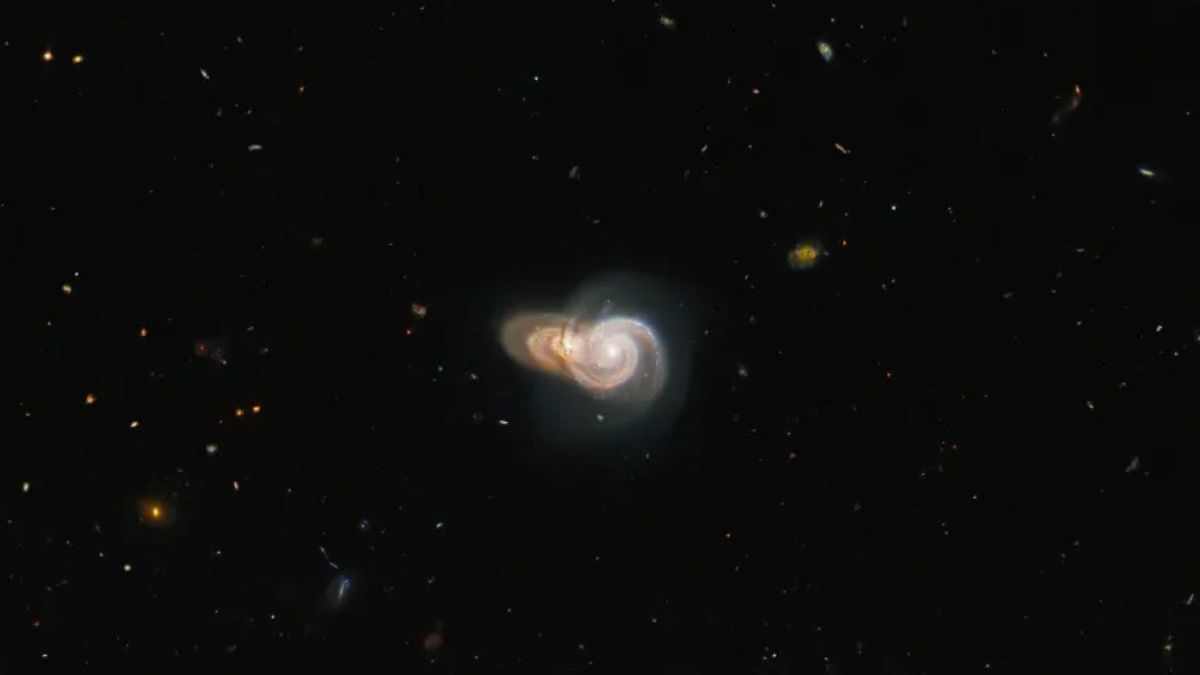
Hubble has done it again. The space telescope operated by NASA and ESA has just delivered a stunning new image of the mysterious galaxy NGC 2775—and astronomers are buzzing. Sitting about 67 million light-years away in the Cancer constellation, this galaxy is causing confusion for one simple reason: it refuses to fit into any single box.
At first glance, NGC 2775 looks calm and smooth, like an elliptical galaxy. But look again, and you’ll see patches of dust and star-forming regions typical of spirals. It’s a cosmic identity crisis in full swing. So what exactly is this galaxy—and why is it lighting up in pink?
Table of Contents
Mystery

Let’s start with the basics. Galaxies are usually classified into three types: spiral, elliptical, or irregular. Spirals have beautiful swirling arms full of gas and young stars. Ellipticals are more uniform, older, and quieter. But NGC 2775 seems to be borrowing features from both.
Its core is smooth, quiet, and gas-free—classic elliptical behavior. But its outer disk is ringed with scattered dust and young stars. Because of this mix, some scientists think it could be a lenticular galaxy, something that exists between spirals and ellipticals.
Hybrid
Lenticular galaxies are like the middle children of the universe. They often have a disk-like shape, similar to spirals, but without the vibrant arms or active star birth. At the same time, they can look older and more settled, like ellipticals.

So how do lenticular galaxies form? Astronomers still aren’t sure. But two main theories exist:
- They start as spiral galaxies and lose their gas after merging with other galaxies.
- Or they begin as ellipticals and collect gas later, forming a thin disk.
Either way, lenticulars represent a transitional stage in galaxy evolution. And NGC 2775 seems to fit that description perfectly.
Mergers
There’s also real evidence that NGC 2775 had a messy past. Astronomers have detected a giant tail of hydrogen gas stretching nearly 100,000 light-years around the galaxy. That’s the kind of thing you see when a galaxy absorbs or collides with others.

These kinds of mergers could explain its strange appearance. Imagine a spiral galaxy being slowly torn apart, having its gas stripped and reshaped until it ends up looking smooth and puffed out in the center—with only feathery patches left around the edges. That’s likely what happened here.
Flocculent
Despite all the debates, most astronomers now call NGC 2775 a flocculent spiral. No, it’s not a bad hair day—“flocculent” just means its spiral arms are fuzzy, broken, and irregular. Unlike galaxies with clear, sweeping arms like the Milky Way, flocculent spirals are more chaotic. Their stars are spread in scattered clumps, forming patchy patterns that still hint at a spiral shape.
These galaxies are often quieter when it comes to star formation, and their structure changes more slowly over time. But NGC 2775 still has something surprising going on.
Stars
That’s where Hubble’s latest image comes in. The new picture includes data taken at a specific wavelength of red light—the kind emitted by hydrogen gas clouds. These clouds form around hot, young stars and show up as bright pink clumps in the image.
That pink glow isn’t just pretty. It reveals something crucial: even though NGC 2775 looks calm and old in the center, it’s still forming stars in its dusty outer ring. These are the baby stars of the galaxy, still wrapped in their warm, glowing birth clouds.
Detail
This kind of image helps astronomers answer big questions—like how long galaxies can keep forming stars, and how their structures evolve over time. With each new wavelength and layer of data, we see more of what’s really going on under the surface.
It also gives us a chance to compare galaxies like NGC 2775 to others we’ve seen. Some galaxies are dramatic and chaotic. Others are quiet and settled. NGC 2775, on the other hand, is somewhere in between—a smooth-looking galaxy with pockets of activity still bubbling beneath the surface.
Wonder
For the rest of us, this isn’t just about space science. It’s about wonder. It’s about remembering that the universe is full of surprises. Even in galaxies that look simple and uneventful, there’s always something new happening. A patch of gas. A cluster of stars. A pink glow marking the birth of something huge.
Thanks to Hubble, we don’t just get to imagine it—we get to see it. We get to explore galaxies millions of light-years away from our tiny planet and understand just a little more about how everything fits together.
So the next time you gaze up at the night sky, remember: galaxies like NGC 2775 are out there, quietly evolving, slowly forming stars, and revealing their secrets one image at a time.
FAQs
Where is NGC 2775 located?
It’s 67 million light-years away in the Cancer constellation.
Why is NGC 2775 hard to classify?
It shows both spiral and elliptical features.
What are the pink spots in the Hubble image?
They’re hydrogen clouds where new stars are forming.
What is a flocculent spiral galaxy?
A galaxy with patchy, broken spiral arms instead of clear ones.
Did NGC 2775 merge with other galaxies?
Yes, a hydrogen tail suggests past mergers occurred.