A stunning discovery high in the Swiss Alps has rewritten what we thought we knew about the reach of the Roman Empire. At over 2,200 meters above sea level, a Roman military camp has been unearthed at Colm la Runga, showing us that Roman legions were more adaptable—and more widespread—than anyone imagined.
Packed with military artifacts, defensive structures, and even signs of advanced Roman engineering, this camp proves that the Empire extended into the harshest mountain terrain with strategic precision.
Table of Contents
Discovery

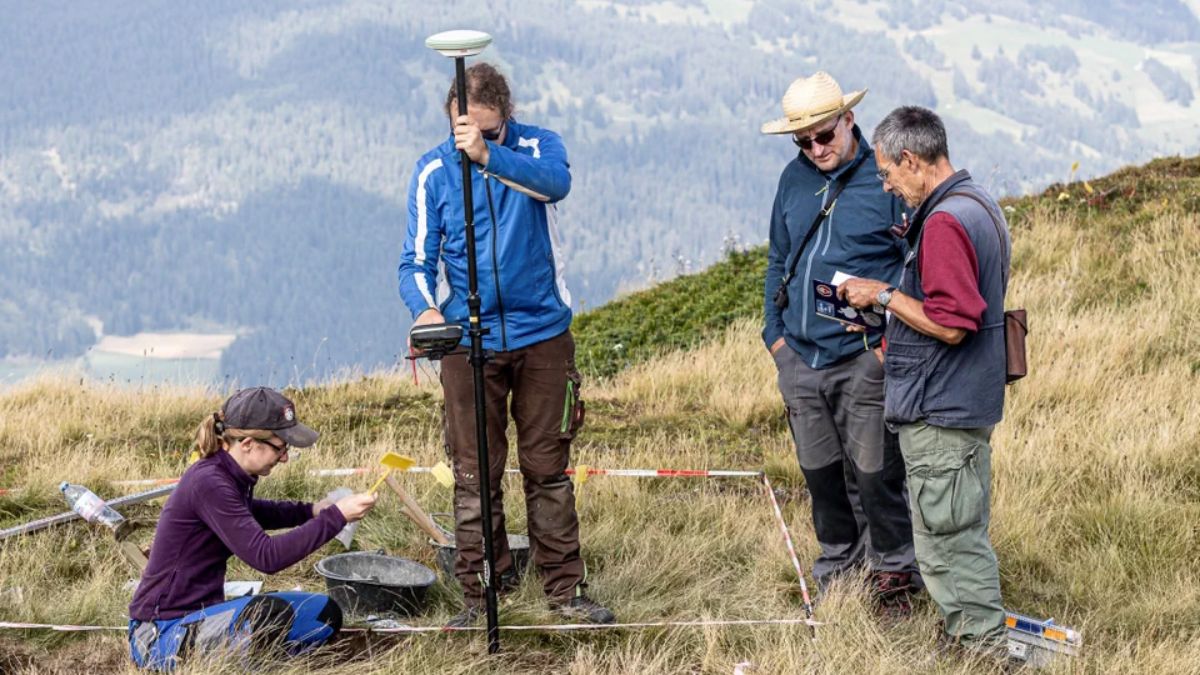
Let’s start with how this all came to light. In 2023, a curious volunteer used LiDAR technology—an aerial laser scanning system—to sweep the thickly forested alpine terrain. What popped up on the scans were not just random shapes, but a clear layout resembling a military fortification. Fast forward to 2024, archaeologists from the University of Basel, along with students, visited the site for verification.
Instead of digging up the ground, they chose a low-impact method. They carefully mapped the outlines of walls, defensive ditches, and platforms. Their findings confirmed the site wasn’t natural—it was a man-made Roman camp.
Altitude
At 2,200 meters, Colm la Runga isn’t your average battlefield. The camp overlooks several valleys—Landwasser, Albula, Domleschg, and Surses. More importantly, it provides a commanding view of Lenzerheide Pass, a crucial route through the Alps. From up there, Roman soldiers could spot and monitor all movements across the mountain range.

This wasn’t just a resting spot. It was a strategic outpost built with a clear purpose: control.
Evidence
The real smoking gun came from the artifacts found at the site. Among the standout pieces:
- Lead sling bullets
- Military sandal nails
- A projectile stamped with the seal of Legio III
All signs point to Roman military activity around the 1st century B.C., specifically around 15 B.C., when Emperor Augustus launched major campaigns to conquer and control the Alpine region.
Design

This wasn’t a makeshift camp thrown together in haste. The soldiers built:
- Three deep defensive ditches
- A solid perimeter wall
- Platforms for supplies, rest, and tactical coordination
Imagine freezing winds, rocky ground, and unpredictable snow—and yet, Roman engineers designed a fully operational base in these harsh conditions. That level of preparation shows serious planning and long-term intent.
Here’s a quick breakdown of the Roman camp features:
| Feature | Purpose |
|---|---|
| Defensive Ditches | Protection against enemy attacks |
| Perimeter Wall | Camp security and structure |
| Platforms | Daily operations, supplies, and rest |
| Elevated Position | Surveillance and signal communication |
Strategy
Why would Rome go to such extremes? The answer is strategy. The Alps weren’t just scenic mountains—they were the gateways between the northern and southern parts of the empire. Whoever controlled the passes controlled trade, troop movements, and vital communication lines.
By placing a camp in this location, Rome:
- Monitored key mountain passes
- Prevented enemy ambushes
- Protected supply routes
- Ensured faster response in case of rebellion or conflict
It’s also likely the camp was linked to the nearby battlefield of Crap Ses, acting either as a forward base or a retreat station.
Legacy
This discovery upends the old belief that Romans only set up shop in Switzerland’s lowlands. Now, we know they weren’t afraid of icy altitudes or rugged terrain. In fact, they thrived in it.
It’s a powerful reminder of how resourceful and disciplined Roman forces were. They could climb mountains, build fortresses, and still keep control over distant provinces. It also opens the door for new research, as archaeologists now suspect there may be more hidden camps scattered through the Alps.
Future digs and technology may reveal:
- How large the camp really was
- How many soldiers lived and worked there
- Whether it was connected to other high-altitude Roman sites
So, next time you look at a snow-covered mountain peak, think twice—it might just be hiding ancient secrets.
Thanks to this incredible find, we now see the Roman Empire in a new light: not just powerful, but also daring and tactical. It’s one thing to build roads across Europe, but building military camps above the clouds? That’s legendary.
FAQs
Where is the Roman camp located?
It’s at Colm la Runga in the Swiss Alps, 2,200 meters high.
What proves it’s a Roman site?
Artifacts like sling bullets and Legio III emblems confirm it.
When was the camp built?
It dates back to around 15 B.C., during Roman Alpine campaigns.
What technology found the camp?
LiDAR scanning was used to detect the hidden structures.
Why was the camp placed so high?
To monitor key mountain passes and control Alpine routes.