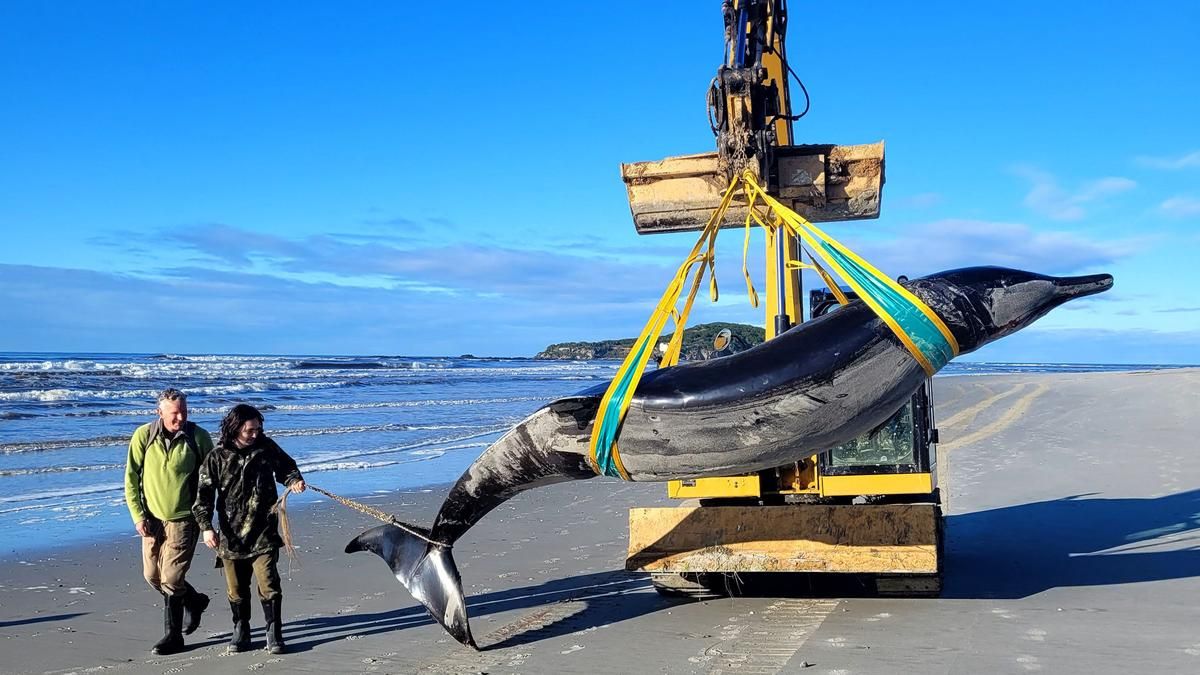
It’s official — the ginkgo-toothed beaked whale (Mesoplodon ginkgodens), long thought to be little more than marine folklore, has finally been seen alive. After years of only knowing it through washed-up corpses and scattered DNA, researchers have recorded, photographed, and sampled this elusive deep-sea creature for the very first time.
And if that wasn’t enough, this groundbreaking sighting has also solved a decade-old mystery about an unexplained whale sound in the Pacific Ocean. It’s a moment of triumph not just for marine biology, but for anyone who ever believed that some legends are real.
Table of Contents
Ghost

For decades, this whale was nicknamed the “ghost of the Pacific” — a species never seen alive, and known only through stranded remains on remote beaches or scraps of DNA. Nobody had ever laid eyes on a living specimen, let alone captured one on camera.
Until June 2024, that is.
Off the coast of Baja California, Mexico, researchers scanning the ocean with hydrophones and cameras were stunned when a group of ginkgo-toothed beaked whales surfaced briefly near their boat. It was enough time to take photos, collect sound recordings, and even extract a skin sample from a young male using a scientific biopsy crossbow.

And with that — a ghost became real.
BW43
But this sighting did more than confirm a species — it also solved the mystery of BW43, a strange acoustic signal picked up for years by underwater listening devices throughout the North Pacific.
Scientists knew the unidentified echolocation sound came from a whale, but no known species matched it.

Now, using the new audio recordings made during the encounter and matching them with the DNA sample, scientists have confirmed: BW43 belongs to Mesoplodon ginkgodens.
That means we can now track this whale by sound, even when we can’t see it.
Teeth
What makes the ginkgo-toothed beaked whale so fascinating isn’t just its rarity. The males of this species grow two flat, leaf-shaped teeth — hence the “ginkgo” name — that protrude near the tip of their snout.
These teeth aren’t for eating. Instead, they’re used to fight other males, likely over mates. Many of the whales spotted had scars and long white scratches, clear signs of these underwater battles. Some even bore circular bite wounds from a predator called the cookiecutter shark.
So although it’s rarely seen, this is a tough, battle-worn species living in one of Earth’s most extreme environments.
Stealth
You might be wondering: why has no one seen this whale before?
A few reasons:
- It lives in deep, remote ocean regions
- It can dive for over an hour at incredible depths
- It surfaces briefly and quietly just to breathe
- It actively avoids boats
Even though they measure over four metres long, they’re effectively invisible to us — unless, by some miracle, they reveal themselves.
Oulu
This discovery was the result of an international collaboration, including scientists from the University of Oulu and the Geological Survey of Finland, working together with marine mammal experts and acoustic researchers. It’s an example of how global teamwork and new tech can finally crack age-old puzzles.
Next
Now that we can link BW43 to this whale, researchers can begin mapping its habitat, tracking populations, and even monitoring threats, like:
- Commercial fishing
- Shipping routes
- Deep-sea mining
- Underwater noise pollution
And next? They’re setting their sights on an even bigger challenge: Perrin’s beaked whale, a species so elusive, it’s never been seen alive and is known from just six carcasses.
But now, armed with networks of hydrophones, smart buoys, and a growing catalogue of whale sounds, scientists have their best shot yet.
We’re living in a time when myth is meeting science, and we get to witness it.
FAQs
What is the ginkgo-toothed beaked whale?
A rare deep-sea whale with leaf-shaped teeth, just seen alive for the first time.
What is BW43?
A mysterious whale sound, now confirmed to be from Mesoplodon ginkgodens.
Where was the whale seen?
Off the coast of Baja California, Mexico in June 2024.
Why is this whale so hard to find?
It lives in remote areas, dives deep for long periods, and avoids boats.
What’s next for scientists?
Tracking the whale’s habitat and finding the even rarer Perrin’s beaked whale.