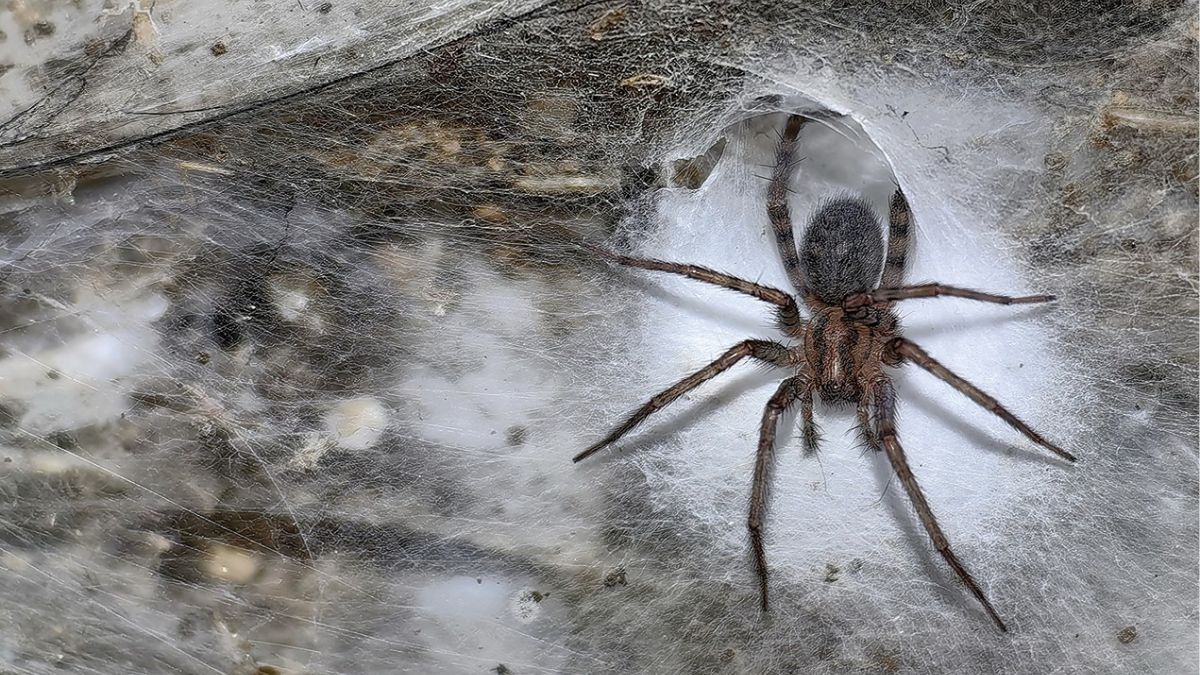
If you’re even a little afraid of spiders, brace yourself. Scientists in Europe have discovered something straight out of a nightmare—or a nature lover’s dream. Hidden inside a sulfur-rich cave between Albania and Greece, researchers found the largest spider web ever recorded. Measuring an astonishing 106 square meters, this web is home to more than 111,000 spiders living side by side. Yes, really.
It’s a discovery that has stunned biologists and made social media users squirm. But as creepy as it sounds, this spider mega-structure could teach us a lot about evolution, survival, and cooperation.

Let’s look into the fascinating world of this giant spider web.
Table of Contents
Discovery
The discovery was led by scientists from Sapientia Hungarian University who ventured into a poorly explored cave system in Vromoner Canyon. What started as a simple speleology (cave exploration) trip in 2022 turned into a full scientific mission in 2024 after they noticed something strange: a shimmering white wall that seemed to move.
That “wall” was actually an enormous, living web. When researchers returned with a team of biologists, they confirmed it wasn’t just one big spider web—it was a whole colony, teeming with two species of spiders: Tegenaria domestica and Prinerigone vagans.

And they were living in complete harmony.
Community
Spiders are usually solitary creatures. They’re known to be territorial and sometimes even cannibalistic. But in this cave, something different happened. Over 111,000 spiders were found coexisting peacefully. No fighting, no drama, just teamwork.
They hunt together, maintain their giant web, and occupy different layers of the structure—almost like neighbors in a high-rise apartment. It’s as if these eight-legged creatures have formed a cooperative society.
Environment

The cave is no spa retreat. It’s filled with sulfur, acid vapors, and toxic air. It’s dark, damp, and hostile. But this extreme environment may be exactly what forced these spiders to adapt and survive in unusual ways.
At the bottom of this strange food chain are microorganisms that thrive in sulfur-rich conditions. These tiny lifeforms support a fragile but effective ecosystem, feeding insects that, in turn, become spider food.
And since it’s pitch black down there, the spiders have had to adjust. They’ve likely evolved special vision and behaviors that help them hunt and live without light.
Structure
The spider web itself is nothing short of an engineering masterpiece. Rather than a single sheet, it’s made of overlapping layers, forming a dense, sticky mesh that acts like a giant trap.
- Some spiders act as guards, constantly patrolling.
- Others remain still, ready to pounce on anything that falls in.
- And the rest work like web maintenance crews, repairing and reinforcing the structure.
The humidity in the cave helps preserve the silk, allowing the web to last for years and grow to its record-breaking size. No wonder scientists have never seen anything like it before.
Significance
This isn’t just a cool (or terrifying) story. It’s a major scientific breakthrough. Researchers are now diving deeper into:
- How light and chemical conditions affect spider behavior
- Why these two species cooperate instead of compete
- Whether the silk has unique properties that could be useful in technology or medicine
If this silk turns out to be more durable or resistant to harsh environments, it could inspire new materials for use in clothing, building, or even space exploration.
Even more fascinating is the idea that this discovery could change what we know about evolution and cooperation. If usually solitary predators like spiders can live peacefully in a community, what else might nature be hiding from us?
Reactions
Once images and videos of the web hit social media, reactions exploded. Some people were fascinated, others were downright horrified. Seeing a 106-square-meter wall of web crawling with thousands of spiders is enough to make anyone’s skin crawl.
Comments ranged from “amazing!” to “nope, I’m moving to another planet.” And let’s be honest, thinking about 111,000 spiders staring at you with 888,000 eyes is a little intense.
But here’s the thing—they’re harmless. These spiders live deep underground, far from people, and they’re part of an incredible natural story that shows just how surprising evolution can be.
Who would’ve guessed that in a toxic cave, spiders would learn to live together in peace? Welcome to the spider city.
FAQs
Where was the giant web found?
In a sulfur cave between Albania and Greece.
How big is the spider web?
It measures over 106 square meters.
How many spiders live there?
More than 111,000 spiders share the web.
Are these spiders dangerous?
No, they live deep underground and pose no threat.
Why is this discovery important?
It shows cooperation in spiders and may lead to new materials.