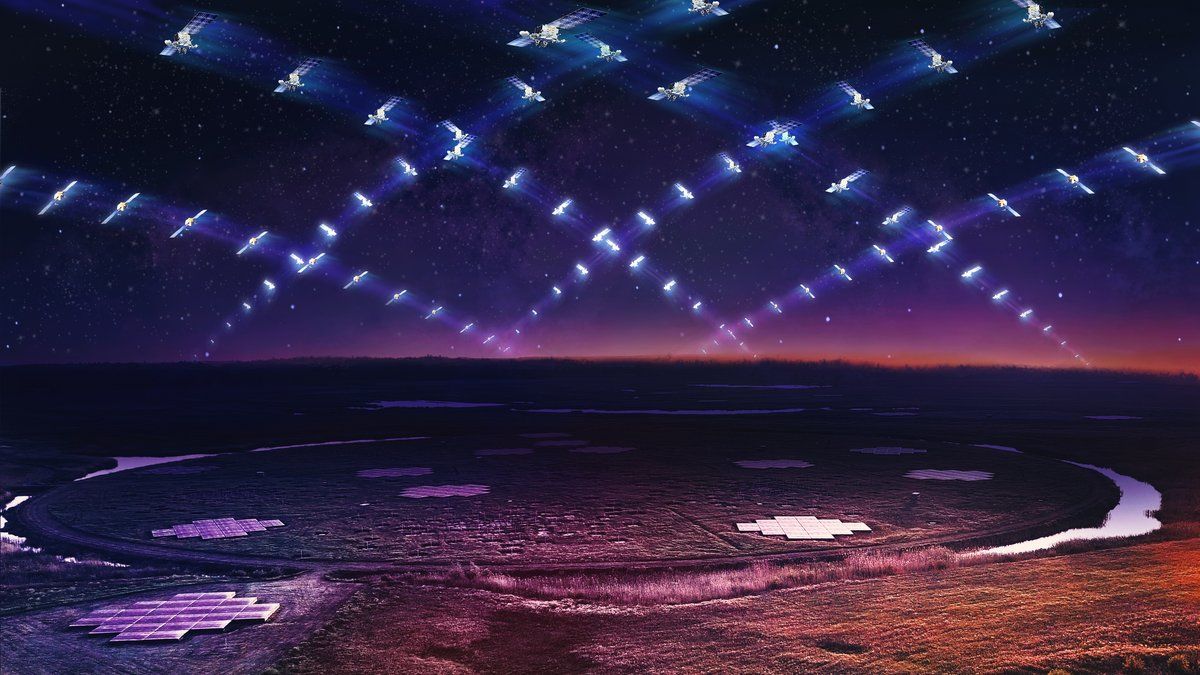
Starlink satellites have become nearly synonymous with global internet access. SpaceX’s constellation promises fast, low-latency internet, especially for remote areas. But while the world praises the improved connectivity, astronomers are sounding the alarm. The second generation of Starlink satellites—called V2-mini—isn’t just a tech upgrade. According to researchers, they’re also producing radio interference 32 times stronger than before.
You can’t see it, you can’t feel it—but this kind of interference could permanently damage how we study the universe.
Table of Contents
Interference

To understand the concern, let’s talk about radio telescopes. These instruments are like giant ears pointed at the sky, listening for the faintest signals from distant galaxies, black holes, and cosmic origins. They pick up ultra-weak radio waves—so weak that even the smallest interference can drown them out.
Now imagine trying to hear a whisper from miles away… while someone blasts a foghorn next to you. That’s what these V2-mini satellites are doing. A recent study using the LOFAR telescope in Europe confirmed that the V2-mini satellites emit signals up to 32 times more powerful than previous Starlink models.
That’s not just a bump—it’s a blinding flood of radio noise that blocks out the cosmos.
Conflict

Here’s where things get tricky. On one side, technology is advancing at breakneck speed. SpaceX is launching satellites at a rate we’ve never seen before. On the other side, science needs peace and quiet—specifically, radio silence.
Astronomy thrives in an electromagnetic quiet zone, free from human-made noise. But Starlink V2-mini and other similar systems are filling space with powerful emissions. Scientists warn that we’re approaching a critical moment. According to astronomer Federico Di Bruno from the SKA Observatory, humanity faces a “turning point.” If action isn’t taken now, the damage to our view of the universe could become irreversible.
Acceleration
The issue isn’t just the satellites. It’s the pace of their deployment. SpaceX alone has thousands already in orbit and plans to launch tens of thousands more. Meanwhile, regulations lag far behind, and there’s little coordination between tech companies and scientific communities.

Some bright spots exist—like the Netherlands’ ASTRON program, where scientists, engineers, and government bodies collaborate to find solutions. But progress is slow, and launches aren’t waiting.
Sky
We often think of the night sky as a universal experience—a view we all share, no matter where we are. But that might change. Scientists warn that we’re heading toward a future where stars are outnumbered by satellites, and constellations aren’t natural anymore, but man-made clusters of metal and signals.
It’s not just about internet vs astronomy—it’s about preserving something as shared and ancient as the sky itself.
Coexistence
No one wants to lose access to technology that helps millions, especially in underserved regions. Starlink and similar systems provide a lifeline for education, health, and communication. But that doesn’t mean science should be sacrificed.
Astronomy isn’t just for scientists—it’s how we understand our place in the universe. Losing that ability would be a tragedy for humanity as a whole. Astronomers argue that technological progress must include responsible practices, like shielding emissions or designing quieter systems.
Responsibility
The Starlink V2-mini case is a wake-up call. Companies must be held accountable for their impact on space, not just on Earth. The sky isn’t private property—it’s a global commons, and treating it as a dumping ground for noise could have serious consequences.
If we don’t act, the cost won’t just be scientific. It will be cultural, historical, and even spiritual. The stars have always been a source of wonder and discovery. Do we really want to replace them with blinking artificial dots?
We’re at a crossroads. Let’s hope for balance—between connection and contemplation, between satellites and stars.
FAQs
Why are scientists concerned about Starlink V2-mini?
They emit 32x more radio interference, affecting astronomy.
What does radio interference do to telescopes?
It drowns out weak cosmic signals needed for deep space study.
Are there any solutions being proposed?
Yes, like emission shielding and collaboration with scientists.
What is the LOFAR telescope?
A European radio telescope used to detect cosmic radio signals.
Could this affect our view of the night sky?
Yes, satellites may outshine natural stars in the future.