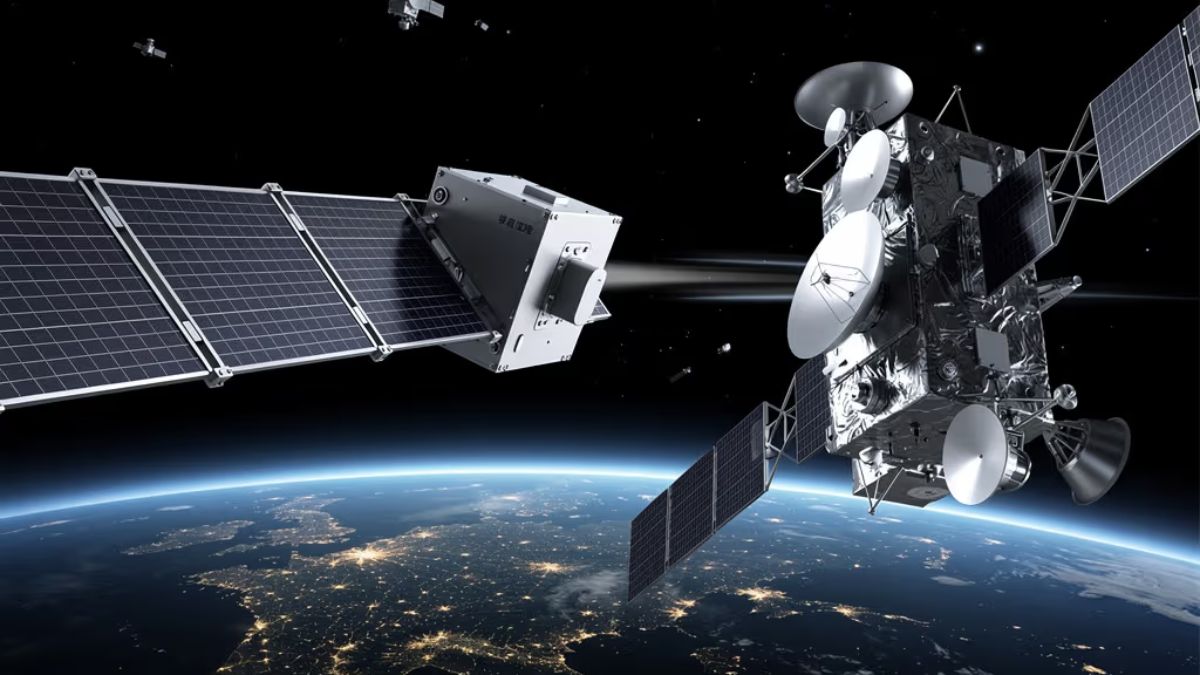
In recent days, a close call between a SpaceX Starlink satellite and a newly launched Chinese satellite has raised serious concerns about the future of satellite traffic in Earth’s orbit.
While the two objects didn’t crash, they came dangerously close — just 200 meters apart — and that’s way too close for comfort when you’re flying at thousands of kilometers per hour in space. This incident is more than a near miss; it’s a red flag for how congested and uncoordinated space operations are becoming.
Table of Contents
Incident

According to SpaceX, the drama unfolded shortly after a launch from China’s Jiuquan Satellite Launch Center. Nine satellites were sent into orbit, but Starlink says there was no coordination or prior communication about the mission. One of those satellites ended up flying alarmingly close to an active Starlink satellite — STARLINK-6079 — operating at around 560 kilometers above Earth.
Michael Nicolls, VP of Starlink Engineering, took to social media to share the details and concerns. He pointed out that even though a collision didn’t occur, the margin was razor-thin — a mere 200 meters. In orbital terms, that’s like threading a needle during an earthquake.
Proximity
To understand how serious this is, you have to consider how fast satellites move in low Earth orbit. We’re talking about speeds upwards of 27,000 kilometers per hour. At those speeds, even a small object can cause catastrophic damage. A 200-meter gap is effectively nothing in that context.

Let’s compare it with a simple analogy: imagine two race cars traveling at full speed on parallel tracks, separated by the width of two basketball courts. Now imagine one swerves slightly. That’s the kind of danger we’re dealing with in orbit.
Here’s a table to put this in perspective:
| Measurement | Value |
|---|---|
| Starlink Satellite Altitude | 560 km above Earth |
| Close Approach Distance | 200 meters |
| Relative Speed in Orbit | ~27,000 km/h |
| Satellites Involved | STARLINK-6079 & CAS Space sat |
Silence
Starlink didn’t just share its side of the story; it also pointed to a China Daily article reporting on the same launch. The piece mentioned the satellite deployment by CAS Space, a Chinese private space company. However, what the article didn’t include was any acknowledgment of the near-collision or comment on coordination procedures.

No response has come from CAS Space or Chinese officials so far. The silence is deafening, and it’s part of what worries Starlink and many others in the space community.
Risks
Michael Nicolls made it clear: the biggest danger in orbit isn’t technical failure — it’s the human side of things. It’s the lack of communication, planning, and international coordination that’s putting hundreds, if not thousands, of active satellites at risk every day.
He highlighted that the problem isn’t new, but it’s growing. With more commercial players entering the space race, the skies above us are becoming more crowded than ever. But what hasn’t kept up is the system of governance or coordination between satellite operators from different countries or companies.
Coordination
Let’s face it — space is starting to look like a highway without traffic lights or road signs. Everyone’s moving at full speed, but nobody’s talking to each other. That’s a disaster waiting to happen.
Starlink is calling for mandatory coordination between space-faring entities. It’s not enough to launch satellites into orbit and hope for the best. With every launch, there needs to be clear communication with others already operating in that same space.
Imagine if commercial airlines didn’t talk to air traffic control or each other. That kind of chaos would never be acceptable on Earth — and it shouldn’t be acceptable in orbit either.
Future
This near miss is a wake-up call. The more satellites we send into space without agreed-upon traffic rules, the higher the chances of disaster. Starlink’s public statement is a push for change, urging global stakeholders to come together and establish clear rules for coordination.
The truth is, space might be infinite, but low Earth orbit isn’t. It’s getting crowded, and with over 4,000 Starlink satellites already in orbit and thousands more planned, every launch without communication is rolling the dice.
So what’s the takeaway? Starlink didn’t just dodge a bullet — it dodged a warning shot. And the message is loud and clear: better coordination isn’t optional anymore. It’s essential if we want to avoid real collisions in the future.
FAQs
How close did the satellites get?
They came within just 200 meters of each other.
Who launched the Chinese satellite?
CAS Space, a Chinese commercial space company.
What altitude was the Starlink satellite at?
It was operating at 560 kilometers above Earth.
Did CAS Space respond to the claim?
No response was given at the time of the report.
What is Starlink asking for?
Better coordination between satellite operators.