It sounds unreal, but it’s true—the Sun actually “rains” fire. Not water, of course, but glowing plasma that falls from its outer atmosphere in what scientists call coronal rain. For years, this fiery rainfall puzzled astronomers. How could something that hot and energetic fall back onto the Sun instead of shooting off into space?
Now, thanks to a breakthrough study from researchers at the University of Hawaii, we finally have an answer. And it all comes down to something surprising: chemistry.

Let’s take a closer look at this incredible discovery that’s changing how we see our closest star.
Table of Contents
Sun
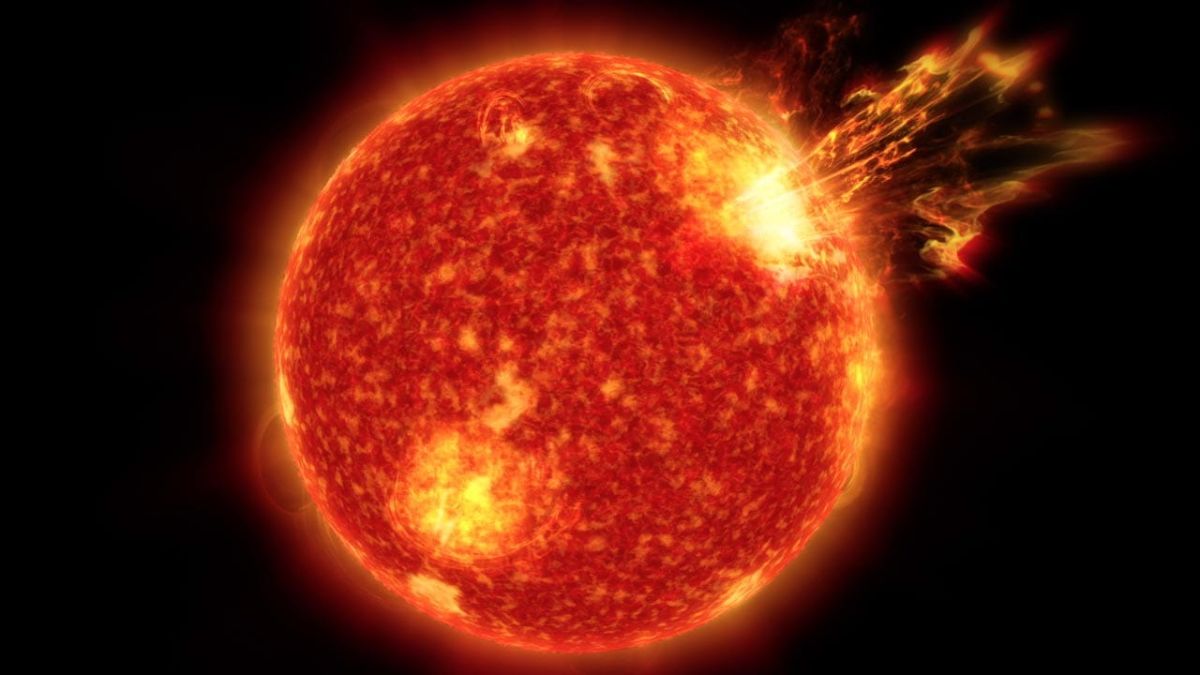
Most of us imagine the Sun as a perfectly round, constant ball of fire. But in reality, it’s far from calm. The Sun is more like a chaotic ocean of magnetic fields, heat, and plasma storms.
Among its many dramatic behaviors, coronal rain stands out as one of the most stunning. Here’s how it works:
- When the Sun erupts with a flare or a magnetic explosion, plasma (a hot, charged gas) shoots up along giant magnetic arches.
- As it rises, some of this plasma cools, becomes denser, and eventually falls back—like glowing rain following invisible tracks.

Through powerful telescopes, it looks like rivers of fire flowing downward from the sky. Beautiful? Yes. But until recently, no one could fully explain why or how it happens.
Mystery
Astronomers have been trying for years to simulate solar rain using computer models. But every time they tried, something was off. The plasma in simulations would stay too warm or too spread out. It never condensed into the thick, fiery “droplets” they actually saw through telescopes.
So, what was missing?
Elements
The missing piece wasn’t about heat at all. It was about what the plasma was made of.
Most earlier models of the Sun assumed it had a uniform chemical composition. But that’s not really the case. In truth, the amount of elements like iron, magnesium, and silicon varies from place to place, and over time.
To test this, the research team led by Luke Fushimi Benavitz, Jeffrey Reep, Lucas Tarr, and Andy To used a simulation program called HYDRAD, which tracks how plasma behaves in the Sun’s magnetic loops. When they added in the real-life chemical variations, everything changed.
Suddenly, the simulations showed solar rain forming naturally, just like in reality.
Why? Because certain elements cause the plasma to lose heat much faster. When these elements are more concentrated, the plasma cools rapidly, condenses into heavy blobs, and falls back—just like rain on Earth.
Change
This discovery challenges a long-standing idea: that the Sun is chemically stable. In fact, it’s not. The Sun’s chemistry shifts all the time.
Plasma from the lower layers pulls up heavier materials into the upper atmosphere, changing the local mix of elements. These changes affect how much energy the plasma can hold, and how fast it cools.
One simulation showed how a patch of plasma rose with heavier material, cooled quickly, and formed a fiery drop that tumbled down along a magnetic loop. Like a lava lamp in reverse—only far more intense.
Weather
So why does this matter to us?
Because knowing solar rain helps us understand space weather—the Sun’s influence on Earth’s atmosphere, satellites, and electrical systems.
If scientists can better predict when and where these plasma flows happen, they can improve space weather models. This means more accurate warnings for things like solar flares that can disrupt GPS, communications, or power grids.
And the bonus? These findings could also help us study other stars. Astronomers have spotted “stellar rain” on distant stars, and now we know this fire-rain might be happening all across the galaxy.
In the end, this fiery rainfall isn’t just a dramatic light show—it’s a window into the deep workings of our star. Every “drop” of plasma falling on the Sun tells a story, not just about heat and magnetism, but about a star that’s far more dynamic, complex, and alive than we ever imagined.
FAQs
What is solar rain?
It’s plasma falling back to the Sun after solar eruptions.
Why does solar rain happen?
Chemical changes cause plasma to cool and fall like rain.
What elements affect solar rain?
Iron, magnesium, and silicon play a key role in cooling.
What is HYDRAD?
It’s a simulator that models plasma behavior in the Sun.
Why does this matter on Earth?
It helps us predict space weather that affects satellites.